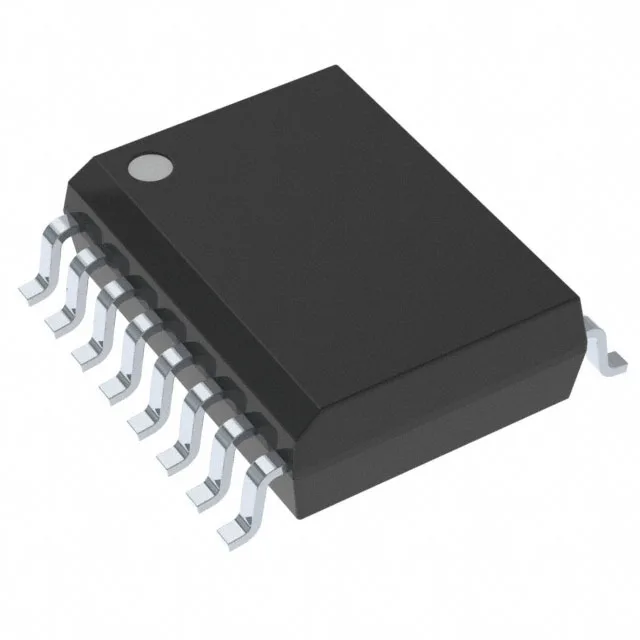
The Texas Instruments ISO7340CDW is a 4-channel, unidirectional digital isolator using capacitive coupling to provide 3000Vrms galvanic isolation across the barrier. It is a general-purpose part intended for breaking ground loops and protecting low-voltage logic on one side from high-voltage transients or noise on the other. Typical applications include industrial fieldbus interfaces (RS-485, CAN), isolated SPI or UART links, motor-drive control signals, and power-supply feedback paths where the signal rate stays within 25Mbps. The wide supply range of 3V to 5.5V lets it bridge 3.3V and 5V domains without a separate level shifter.
Key ratings that decide the fit
The 3000Vrms isolation voltage is the safety rating for basic insulation in mains-connected equipment — it covers reinforced isolation in many 240VAC applications when used per the datasheet clearance rules. The 25Mbps data rate is the maximum guaranteed toggle rate across the barrier; for a 10MHz SPI clock or a 12MHz UART bit stream this leaves margin, but a 30Mbps LVDS link would exceed it. Common-mode transient immunity of 25kV/µs is the key spec for motor-drive and inverter environments: fast-switching IGBTs or SiC FETs can dump several kV/µs across the isolation barrier, and this part holds its output state through that edge without glitching. Propagation delay is 58ns max in both directions, which matters for timing-closure in a control loop — a 58ns one-way delay plus 4ns pulse-width distortion means a 120ns round-trip budget for a closed-loop PWM update.
The 16-SOIC wide-body package provides the 8mm creepage typical for 3000Vrms reinforced isolation — the narrow-body SOIC-8 would not meet the same clearance.
It is ROHS3 compliant.