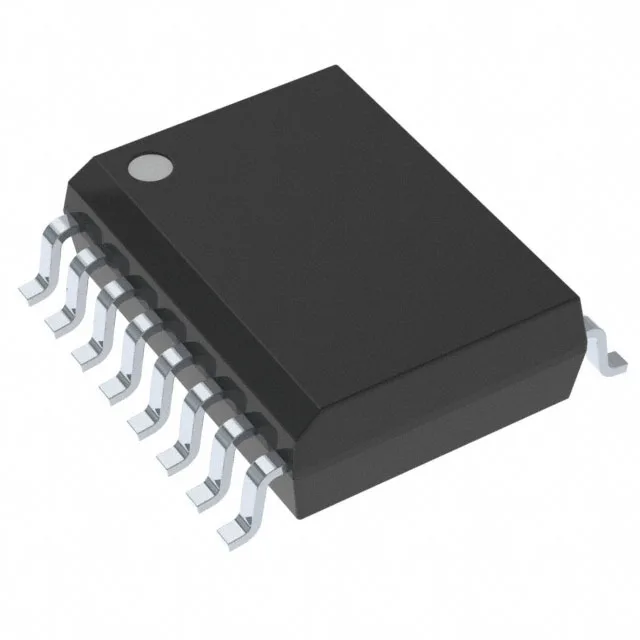
Three-channel unidirectional isolation at 25Mbps
All three inputs are on side 1 with no outputs on that side — a 3/0 configuration that suits applications where all isolated signals flow in one direction, such as sensor-to-controller links or isolated SPI buses where the clock, data, and chip-select all travel from the controller to the peripheral. Rated for 25Mbps, the part handles moderate-speed isolation needs — think isolated UART, CAN transceiver interface, or general-purpose digital signal isolation in industrial fieldbus nodes. The 58ns maximum propagation delay (tpLH and tpHL) and 4ns pulse-width distortion keep timing predictable for synchronous interfaces.
25kV/µs CMTI — what it means for motor-drive and inverter designs
In a motor drive or DC-DC converter, the switching node can slam the isolated ground with several hundred volts in a few nanoseconds. If the isolator's CMTI is too low, the output glitches or latches, corrupting the control signal. At 25kV/µs the ISO7330FCDW handles the slew rates typical of IGBT and SiC gate drives up to moderate switching frequencies. The 3ns rise and 2ns fall times (typical) keep the output edges clean without excessive ringing, which helps with EMI in a tight layout. Capacitive coupling inherently offers better immunity to magnetic fields than optocouplers, so this part is a natural fit for environments with high dI/dt.
Package and supply: 16-SOIC wide-body, single-rail operation
Housed in a 16-pin SOIC wide-body (7.50mm width) package, the ISO7330FCDW provides the creepage and clearance needed for 3000Vrms reinforced isolation in a surface-mount footprint. No isolated power on-chip — the part is a pure signal isolator; the secondary side needs its own supply rail (same 3V to 5.5V range as the primary). The unidirectional channel type means the direction is fixed at design time, so verify the signal flow matches the 3/0 input/output assignment before layout.