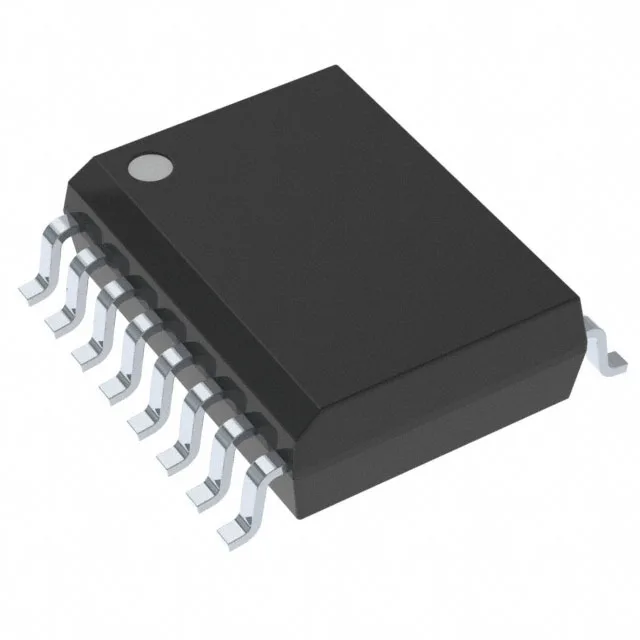
The ISO7241MDW: That means no last-time-buy clock to manage and no forced redesign for a replacement.
150 Mbps data rate — signal integrity margin for high-speed interfaces
Rated at 150 Mbps per channel, this isolator handles SPI clocks up to 75 MHz, CAN FD at full 5 Mbps, or parallel data buses without timing pressure. The 23 ns max propagation delay and 2 ns pulse-width distortion keep skew tight enough to avoid setup/hold violations across temperature. If your link uses a 50 MHz serial clock, you have more than 3x margin on the data rate — no need to derate.
2500 Vrms isolation — where it fits in the system
The 2500 Vrms isolation rating suits reinforced insulation for industrial motor drives, PLC I/O modules, and medical equipment where the safety barrier must withstand 2.5 kV for one minute. Capacitive coupling technology delivers this isolation with 25 kV/µs common-mode transient immunity — enough to reject noise from a 600 V IGBT switching at 20 kHz without bit errors. No isolated power on-chip; you supply separate rails on each side.
Four channels, 3/1 direction split — typical use case
Three channels drive data from Side 1 to Side 2, one channel goes the opposite direction. That 3/1 split matches the typical SPI isolator need: three forward signals (SCLK, MOSI, CS) and one return (MISO). The unidirectional channel type means each channel is hard-wired for one direction — no bidirectional data lines. For half-duplex buses like RS-485 you need an external direction control or a different part.
16-SOIC wide-body package — layout and footprint
Housed in a 16-pin SOIC wide-body (7.50 mm body width), the ISO7241MDW uses a standard surface-mount footprint common across the TI ISO724x family. Creepage distance on the wide-body package supports the 2500 Vrms rating without conformal coating. The tube shipment means it arrives in anti-static tubes, not tape-and-reel — factor that into your pick-and-place setup if you need reel feed.