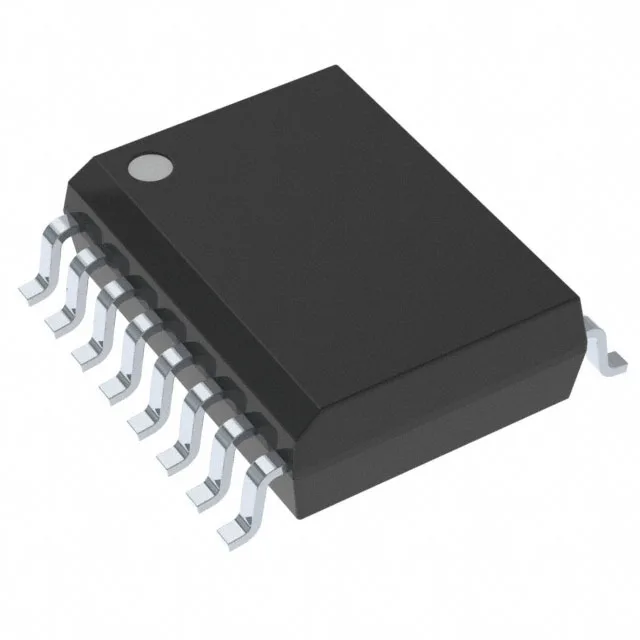
The Texas Instruments ISO7241ADW is a 4-channel digital isolator using capacitive coupling technology, rated for 4000Vpk isolation and a data rate of 1 Mbps. It provides three forward-direction channels (Side 1 to Side 2) and one reverse-direction channel, all unidirectional. The wide supply range from 3.15V to 5.5V lets it bridge 3.3V and 5V logic domains without a level shifter.
The 4000Vpk isolation rating is the headline spec for this part. It means the ISO7241ADW can withstand a 4 kV peak transient between the two sides, which is sufficient for reinforced insulation in many industrial and medical applications. For a procurement decision, this rating determines whether the part can replace an optocoupler-based solution in a design that needs a smaller footprint and higher reliability. The capacitive coupling technology also gives it a typical common-mode transient immunity of 25kV/µs minimum, so data stays clean even when large voltage spikes slam across the isolation barrier — a common failure point in motor-drive and inverter designs.
1 Mbps data rate — is it fast enough?
At 1 Mbps, this isolator handles standard UART, SPI (at moderate clock rates), and general-purpose GPIO isolation. It is not intended for high-speed protocols like USB 2.0 or gigabit Ethernet. The propagation delay is 95 ns max (both directions), and pulse-width distortion is 10 ns max. For a typical 1 MHz clock, that delay is about 10% of the period — fine for most control and sensor interfaces, but check timing margins if you are daisy-chaining multiple isolators or running near the rate limit.
It is surface-mount only. The wide body gives better creepage distance for high-voltage applications compared to the narrow SOIC-16. No exposed thermal pad, so standard reflow profiles for SOIC-16W apply.
That means no last-time-buy risk for current production designs. For dual-sourcing resilience, the ISO7241 family includes other channel-count variants (ISO7240, ISO7242) that share the same base technology and package, but pin compatibility should be verified against the datasheet.