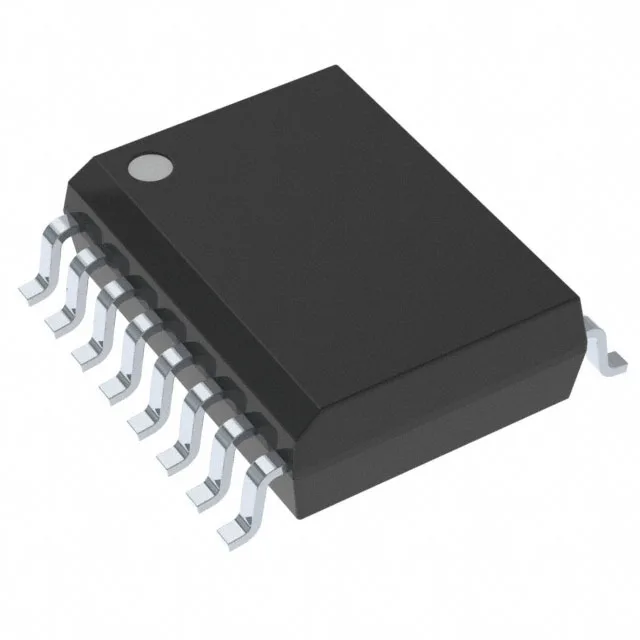
Why the 25Mbps and 2500Vrms matter for your isolation barrier
The Texas Instruments ISO7240CFDWG4 is a 4-channel, unidirectional digital isolator using capacitive coupling to provide 2500Vrms galvanic isolation across a 16-SOIC package. It supports a data rate of 25Mbps, which is fast enough for most SPI, UART, and general-purpose logic-level isolation tasks without the jitter or power penalty of optocouplers. The 42ns max propagation delay (both directions) and 2.5ns pulse-width distortion keep timing margins tight for synchronous interfaces. The supply range spans 3.15V to 5.5V, so it works on both 3.3V and 5V rails without a separate regulator — a practical advantage when the MCU side runs 3.3V and the field side is 5V. The 25kV/µs common-mode transient immunity (minimum) means it holds the barrier clean in motor-drive and inverter environments where fast switching edges couple into the isolation gap.
The 16-SOIC wide-body (7.50mm width) footprint is common for high-voltage isolation parts, giving 8mm creepage between input and output sides — enough for basic reinforced isolation in 250Vrms working-voltage systems.
For production BOMs that require a second-source option, the ISO7240 family includes pin-compatible variants with different channel counts and directionality — the ISO7241 (3/1) and ISO7242 (2/2) share the same 16-SOIC footprint and supply range, allowing a drop-in change without board re-spin if the channel configuration changes.