Automotive CAN isolation with 5000 Vrms and 125°C rating
The 5000 Vrms isolation rating supports reinforced insulation requirements per automotive safety standards.
50 Mbps data rate and propagation delay budget
With a 50 Mbps data rate and 18 ns max propagation delay (tpLH/tpHL), this isolator handles CAN FD at 5 Mbps with margin and supports general-purpose isolation links up to 50 Mbps. The 7 ns max pulse width distortion keeps the duty-cycle error tight for CAN bit-timing budgets. Rise/fall times of 2.6 ns typical mean the signal edges are clean enough for 50 Mbps without excessive ringing, but the PCB layout should keep trace lengths short to avoid reflections at these edge rates.
4/0 channel configuration and supply flexibility
The channel arrangement is 4 inputs on side 1 and 0 inputs on side 2 — all four channels drive in the same direction, which fits a CAN transceiver isolation scheme where the MCU-side signals (TX, RX, standby, fault) all cross the barrier one way. Common-mode transient immunity of 100 kV/µs minimum ensures the data link stays intact during motor-drive switching events or battery disconnect transients.
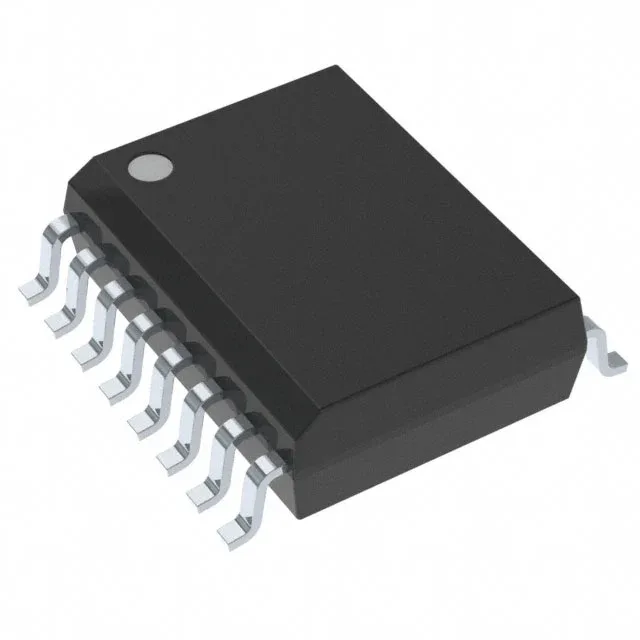
16-SOIC package and surface-mount assembly
The wide SOIC footprint provides the creepage distance needed to maintain the 5000 Vrms isolation rating across the PCB. No isolated power is integrated — the design needs separate isolated supplies on each side, which is standard for CAN isolation where the transceiver side often runs from a 5 V bus supply.
The automotive qualification and active status make it a low-risk choice for production programs that need a documented AEC-Q100 isolator.