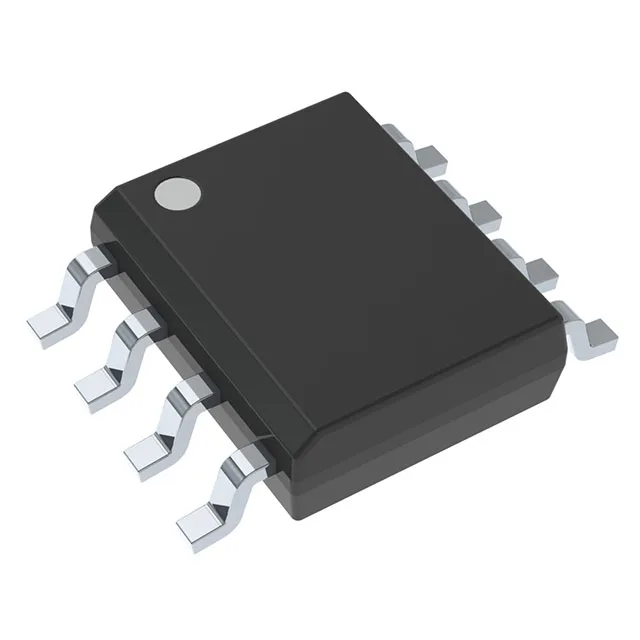
The ISO1044BDR from Texas Instruments is a galvanically isolated CAN transceiver in a compact 8-SOIC package, built for CAN FD buses at data rates up to 5 Mbps in half-duplex operation. Where a plain transceiver such as an SN65HVD230 merely shifts TTL to the CAN differential pair, the ISO1044 puts a digital isolation barrier between the logic side and the bus side, so the controller's ground is electrically decoupled from the bus ground. That matters in motor drives, inverters, and industrial field devices where the bus spans high-voltage, noisy, or ground-separated domains and a ground loop or common-mode surge would otherwise corrupt frames or damage the MCU. The dual supply structure — logic side at 1.71V-1.89V or 2.25V-5.5V, bus side at 4.5V-5.5V — lets you pair a low-voltage CAN controller directly with a 5V bus interface, and the 100 mV receiver hysteresis gives clean reception over long or lightly loaded segments.
Rated for -40°C to +125°C and delivered in tape-and-reel 8-SOIC, the ISO1044BDR fits space-constrained CAN FD nodes in motor-control, battery-management, and automation I/O applications. As a half-duplex 1/1 driver/receiver it wires as a standard two-wire CAN node on the bus side. When selecting, verify your required isolation working voltage and creepage against the module's safety specification, confirm that the 5 Mbps data phase plus lower arbitration rates is what your CAN FD controller needs, and plan a clean isolated supply for the bus side. With those in place, the ISO1044 delivers the ground-loop immunity and noise robustness that non-isolated transceivers cannot.