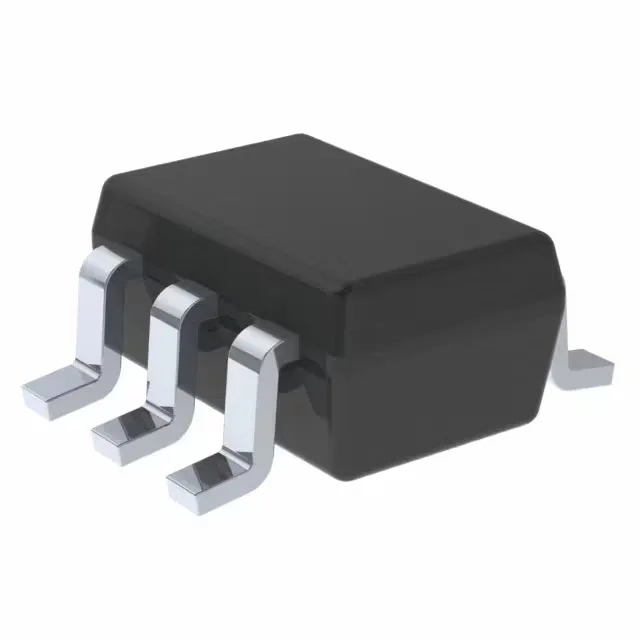
Current-sense amp in a hand-solderable SC-70-6
The INA211AIDCKR is a single-channel current-sense amplifier from Texas Instruments in the SC-70-6 package — that's the same 6-pin footprint as a SOT-363, easy to hand-solder with a fine tip and some flux. With a gain-bandwidth product of 7 kHz and a 0.4 V/µs slew rate, it's tuned for DC and low-frequency current monitoring, not high-speed transient capture.
What the key ratings mean for your BOM
The 65 µA supply current keeps the amp's own draw low enough that it won't skew the measurement on a battery-powered sense resistor — think always-on monitoring in a 24/7 IoT node or automotive module. Input bias current sits at 28 µA, which flows through the sense resistor and adds a small offset error; for a 10 mΩ shunt that's 280 µV of additional drop, something to budget into the calibration routine. Input offset voltage is a tight 0.55 µV, meaning the DC error from the amplifier itself is negligible compared to the voltage drop across a typical shunt — you're reading the shunt drop, not the amp's internal mismatch. The 7 kHz gain-bandwidth limits the useful bandwidth to about 1 kHz for a gain of 7, so pair it with a slow ADC or a filtered input on a microcontroller.
Surface-mount only; no through-hole variant exists.