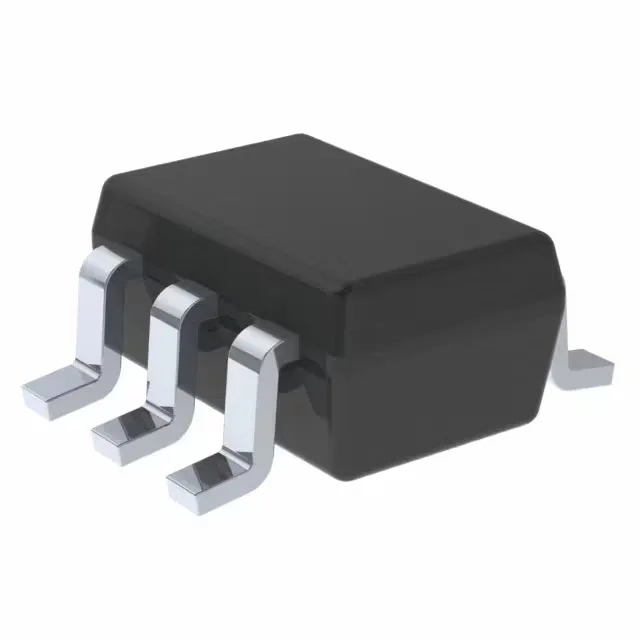
SC-70-6 footprint and board integration
The INA199C3DCKR: This is a surface-mount part — the tiny footprint demands a well-planned PCB layout, particularly for the sense resistor connections that carry the differential input current. The -40°C to 125°C operating temperature range covers industrial control cabinets and under-hood automotive environments. No derating needed across the full span for the amplifier itself — the sense resistor's TCR will dominate the drift budget.
±1% accuracy at the shunt
The INA199C3DCKR delivers ±1% accuracy across its full -0.1V to 26V common-mode input range. That means the total measurement error from the amplifier is bounded at 1% of the reading — the dominant error term will be the sense resistor tolerance and its temperature coefficient, not the IC itself. It senses current on either the high side (between the supply rail and the load) or the low side (between the load and ground). The wide common-mode range lets it handle 12V, 24V, and even 5V rails with margin. No external level shifting needed.
Peer check: INA199B2QDCKRQ1
The INA199B2QDCKRQ1 is a pin-compatible automotive-qualified (AEC-Q100) variant of the same die, specified at 1.5% accuracy instead of 1%. The SC-70-6 footprint, the ±0.1V to 26V input range, and the high/low-side sensing method are identical. If your BOM calls for automotive-grade parts, the B2Q variant drops in with no layout change — just a 0.5% accuracy trade-off.