What this current-sense amp does on the board
It is built for the common low-side and high-side sensing tasks in power supplies, motor drives, and battery-monitoring circuits where you need to measure current without dropping much voltage or burning quiescent power. Its 350 kHz -3 dB bandwidth and 2 V/µs slew rate mean it can track current transients in switching regulators running at a few hundred kilohertz — fast enough for most DC-DC converter loops and motor-phase current feedback, but not intended for RF or high-speed data-line monitoring.
Supply range and quiescent current — BOM-fit decisions
The 260 µA typical supply current is low enough to leave on in always-sense applications — it will not drain a battery or overheat a tightly packed board. Rail-to-rail output swing means the amplifier can drive its output close to the supply rails, preserving dynamic range when the shunt voltage is small. That matters when you are sensing a few milliohms at low current.
Temperature grade and package — where it fits physically
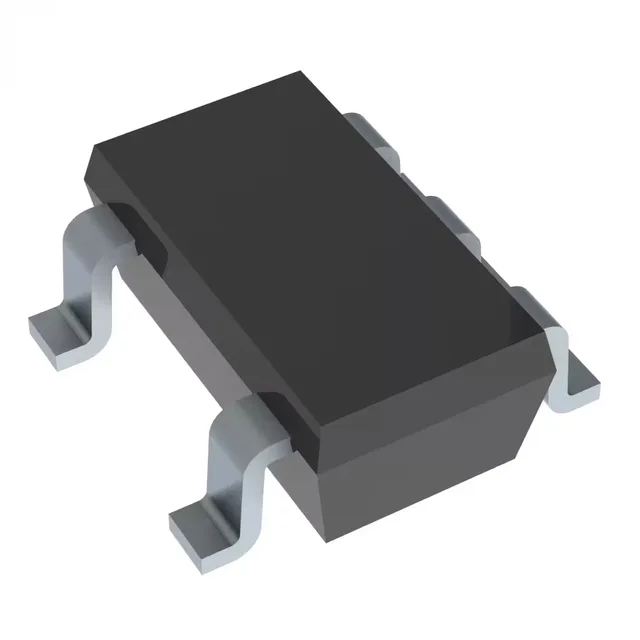
The SOT-23-5 package (SC-74A, SOT-753) is a five-pin surface-mount footprint that fits on compact boards and is straightforward to hand-solder or reflow.