Current-sense amp — 350 kHz bandwidth in a SOT-23-5
The INA180B2IDBVT is a single-circuit current sense amplifier from Texas Instruments, part of the INA180 family. It is designed to measure current by amplifying the voltage drop across a shunt resistor, outputting a rail-to-rail voltage proportional to the sensed current. With a -3 dB bandwidth of 350 kHz and a slew rate of 2 V/µs, this part is suited for monitoring DC or low-frequency AC current waveforms in power management, motor control, and battery monitoring applications. The bandwidth sets the upper limit on the frequency of current ripple that can be accurately tracked — above 350 kHz, the output amplitude rolls off.
Supply range and quiescent draw — always-on monitoring
The 260 µA supply current is low enough for always-on current monitoring in battery-powered equipment — the amp's own draw adds minimal overhead to the system's sleep current. The rail-to-rail output swing means the amplifier can drive its output close to the supply rails, maximizing the dynamic range of the ADC or comparator it feeds. This is especially useful when sensing small shunt voltages at low supply voltages.
Accuracy parameters — input offset and bias current
Input offset voltage is 100 µV, and input bias current is 80 µA. The offset contributes a DC error at the output that must be accounted for in the measurement budget, particularly when sensing low shunt voltages. The bias current flows through the shunt resistor, creating an additional voltage drop that adds to the measurement error — for a 1 mΩ shunt, 80 µA produces just 80 nV of error, negligible in most applications.
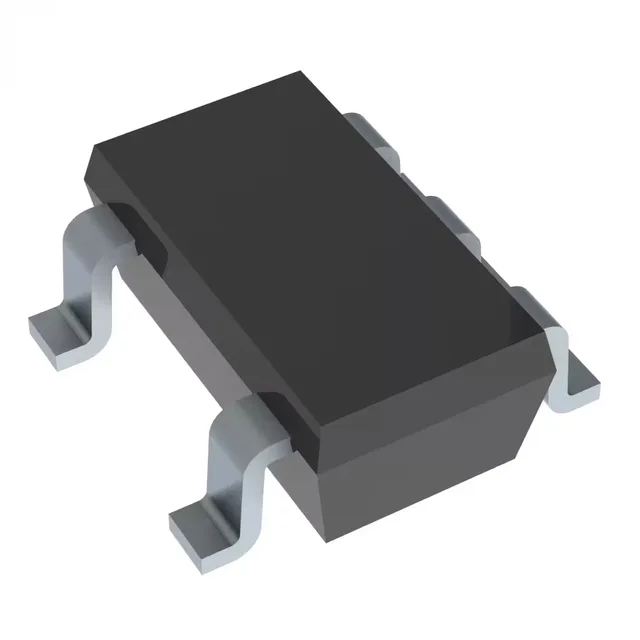
Housed in a SOT-23-5 package (SC-74A, SOT-753), the INA180B2IDBVT occupies a small footprint suitable for space-constrained designs. The surface-mount package is compatible with standard reflow profiles.