Automotive current sense — what the AEC-Q100 grade means for the BOM
It monitors current via a shunt resistor and outputs a rail-to-rail voltage proportional to the sensed current, with a -3 dB bandwidth of 350 kHz and a slew rate of 2 V/µs. The part operates from 2.7 V to 5.5 V supply, drawing 197 µA quiescent current, and is specified over the full -40°C to 125°C ambient temperature range. Typical applications include motor control, solenoid monitoring, and battery current measurement in automotive ECUs, body controllers, and ADAS modules.
350 kHz bandwidth — sizing for switching converter loops
The 350 kHz -3 dB bandwidth sets the usable frequency range for accurate current measurement. In a switching regulator loop running at 200–400 kHz, this amplifier can track the inductor current waveform with enough margin for feedback or overcurrent detection. For higher-frequency converters (above 500 kHz), the bandwidth will roll off the signal amplitude — plan for a wider-bandwidth current sense if the loop compensation depends on the full waveform shape.
Supply range and input bias — rail compatibility check
The rail-to-rail output swings close to both supply rails, preserving dynamic range at low supply voltages.
Package and footprint — SOT-23-5
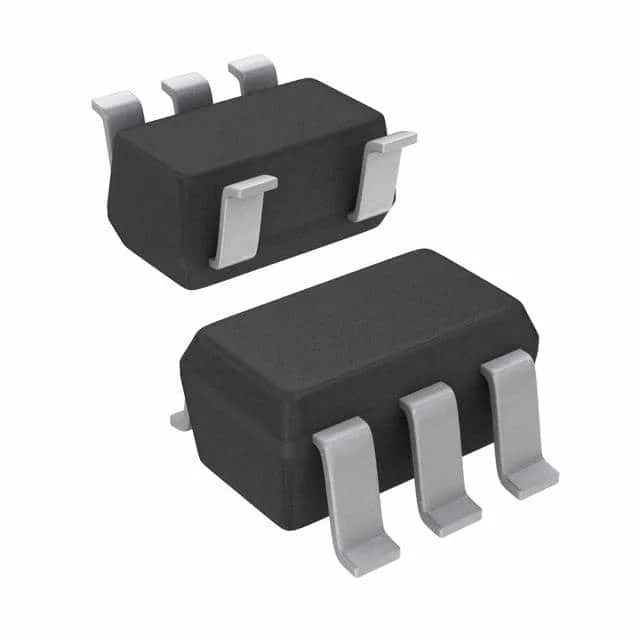
Housed in a SOT-23-5 package (SOT-753), the INA180A1QDBVRQ1 is a surface-mount device with five pins. The small footprint suits space-constrained automotive PCBs. The supplier device package is SOT-23-5, and the mounting type is surface mount.
ROHS3 compliant.