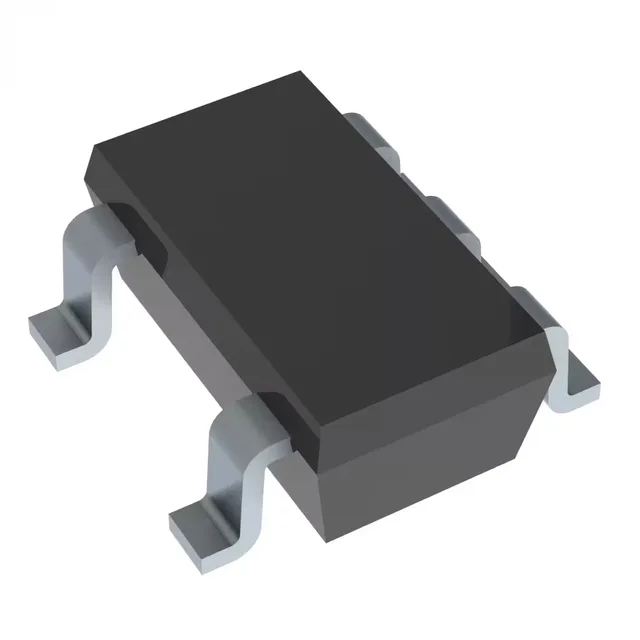
Current-sense amplifier for single-supply rail monitoring
It senses current via an external shunt resistor and outputs a voltage proportional to the shunt voltage, with a rail-to-rail output that connects directly to an ADC or comparator without level shifting. The part operates from a 2.7 V to 5.5 V supply, making it suitable for both 3.3 V and 5 V systems in automotive and industrial environments rated from -40°C to 125°C.
The 350 kHz -3 dB bandwidth and 2 V/µs slew rate define the fastest current transient the amplifier can faithfully reproduce. For a typical 10 mΩ shunt, a 1 A step produces a 10 mV step; the amplifier settles in roughly 1 µs, which is fast enough for overcurrent detection in motor drives, solenoid control, and DC-DC converter output monitoring. If your application requires tracking switching edges above 350 kHz — for example, in a high-frequency power stage — the INA180A1IDBVR will alias or roll off the signal.
Input offset and bias current — impact on low-side vs. high-side sensing
For a 10 mΩ shunt, the offset translates to a 10 mA zero-current error, which is acceptable for load currents above 100 mA but may dominate at very low shunt voltages. The 80 µA bias current flows into the shunt; in high-side sensing, this current returns through the load, adding a small error. The part supports both high-side and low-side configurations, but the bias current and offset should be budgeted when the shunt voltage is below 10 mV.