7 GHz bandwidth sets the DisplayPort lane ceiling
The HD3SS215IZXHT is a 2:1 multiplexer/demultiplexer for DisplayPort signals, with a -3 dB bandwidth of 7 GHz. That bandwidth supports DisplayPort 1.2 (5.4 Gbps per lane) and 1.4 (8.1 Gbps per lane) without introducing a signal-integrity bottleneck — the mux's bandwidth exceeds the 3rd harmonic of a 2.7 GHz fundamental, so the eye diagram at the sink is dominated by the PCB trace and connector losses, not the switch itself. On-resistance is 14 Ohm max. In an AC-coupled DisplayPort lane, R_on adds to the source impedance but does not shift the DC bias point — the coupling capacitors block the DC path. The 14 Ohm figure matters for signal swing: at 8.1 Gbps the channel loss budget is tight, and the mux contributes roughly 0.2 dB of insertion loss at 4 GHz, which is within the DP 1.4 equaliser range.
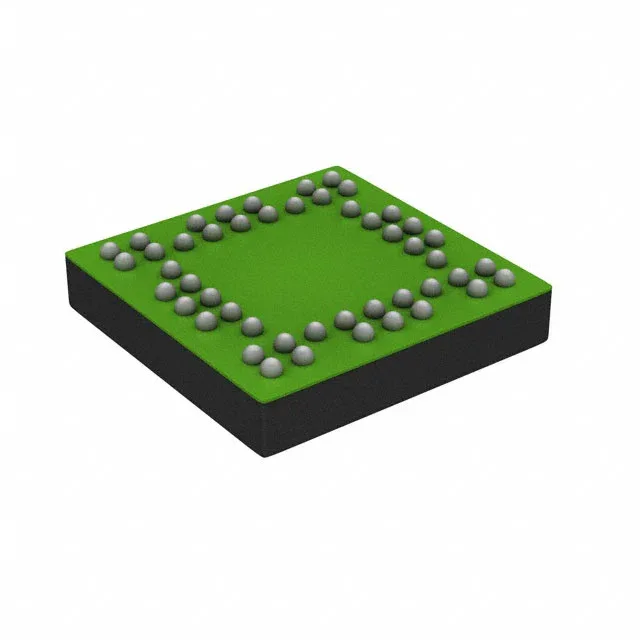
Supply and package: 3.3 V rail, 48-NFBGA fan-out
Single-supply range is 3 V to 3.6 V, nominally 3.3 V. The supply pins should share a clean 3.3 V plane with the GPU or DisplayPort source PHY — any ripple on this rail couples into the mux's internal bias and degrades the output common-mode. A 100 nF ceramic per Vdd pin within 2 mm of the ball is the minimum decoupling. The 48-NFBGA (5x5 mm) package has a 0.5 mm ball pitch. Fan-out requires at least a 4-layer PCB with buried vias or microvias if the inner balls are used for signal routing. The package is 5x5 mm — the same footprint as the HD3SS215 family, so a layout done for the HD3SS215IQZXHR spins in without changes. Operating temperature range is -40 to 85 °C (industrial grade). This covers most consumer, commercial, and industrial indoor equipment, but not automotive cabin or under-hood (AEC-Q100 Grade 2 or 1 would be needed for that). For a rack-mount display controller or a digital signage player in a ventilated enclosure, the 85 °C ceiling gives margin.