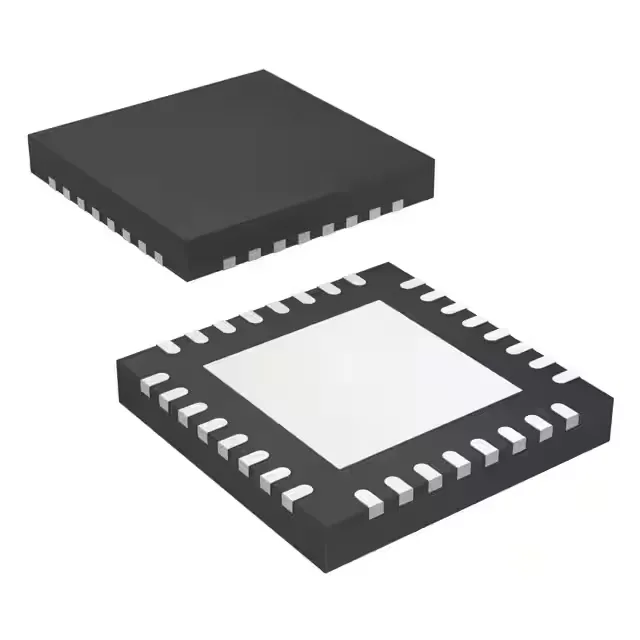
The Texas Instruments DS90LV804TSQX/NOPB is a 4-channel LVDS buffer and signal conditioner — a redriver — that accepts CML, LVDS, or LVPECL inputs and re-transmits them as clean LVDS outputs. It's designed for high-speed serial links where the trace length or connector loss has degraded the eye diagram enough that the receiver at the far end can't reliably recover the data. At 800 Mbps per channel, it handles common LVDS clock and data rates for video interfaces, backplane distribution, and test-equipment front ends. The 2.0 ns propagation delay is short enough that it doesn't eat into the setup-and-hold budget on a multi-drop clock tree, but it's not zero — you budget it in the timing analysis.
Supply rail and power budget
The part runs from a 3.15 V to 3.45 V supply, so it needs a regulated 3.3 V rail — not a 2.5 V or 5.0 V bus. The 117 mA supply current (typical, all four channels active) is the number to plug into the 3.3 V rail budget. If the board already carries a 3.3 V LDO for the FPGA bank or the SERDES transceiver, this redriver can share that rail as long as the total current stays inside the regulator's rating.
The 3.5 pF input capacitance is low enough that it doesn't load the upstream driver significantly, but the layout should keep the differential trace pair from each input to the package pins as short and impedance-controlled as possible — the redriver can't fix a mismatch that happened before it.
Not qualified to AEC-Q100, so it's not the first choice for under-hood automotive — but fine for infotainment or telematics boxes that stay inside the cabin if the system-level temperature spec stays under 85 °C.