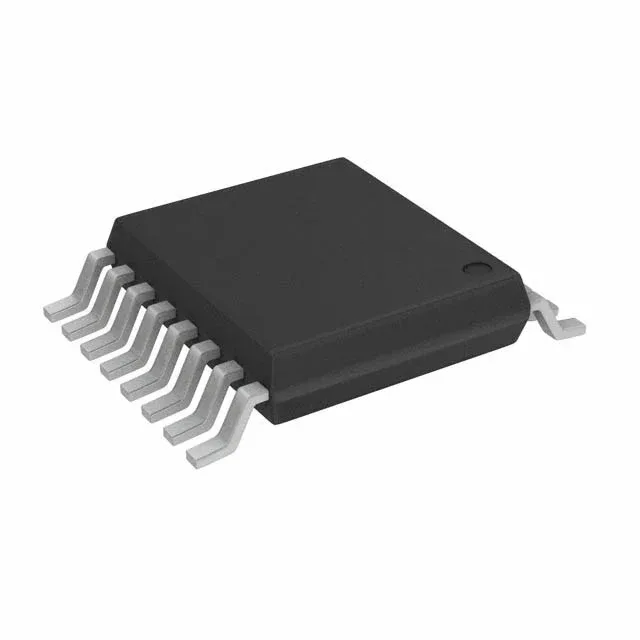
NRND — plan your BOM now
TI is not actively discontinuing it today, but the lifecycle marker signals that a last-time-buy window could open. For production builds already qualified on this receiver, secure your forward volume through independent distribution. For any new board spin, evaluate the pin-compatible DS90LV048A sibling — same footprint, same supply, same 400 Mbps rating — to keep the BOM lane open.
400 Mbps per channel — what it buys on the bus
Each of the four receivers handles 400 Mbps, which translates to a 200 MHz clock-equivalent data rate for NRZ streams. That is enough for a 24-bit RGB video link at 60 Hz with embedded sync, or four aggregated 100BASE-TX MII lanes. The LVDS common-mode range of 0 V to 2.4 V (typical for the family) gives margin across backplane ground shifts. At 400 Mbps, the 16-TSSOP package keeps trace lengths short — route each differential pair within 12 inches of the connector to avoid eye closure.
Supply and temperature — the practical limits
No 2.5 V or 1.8 V option — if your FPGA bank runs at 1.8 V, you need a level translator after the receiver. Storage temperature exceeds this, but the junction limit during operation is what governs reliability in a hot chassis.