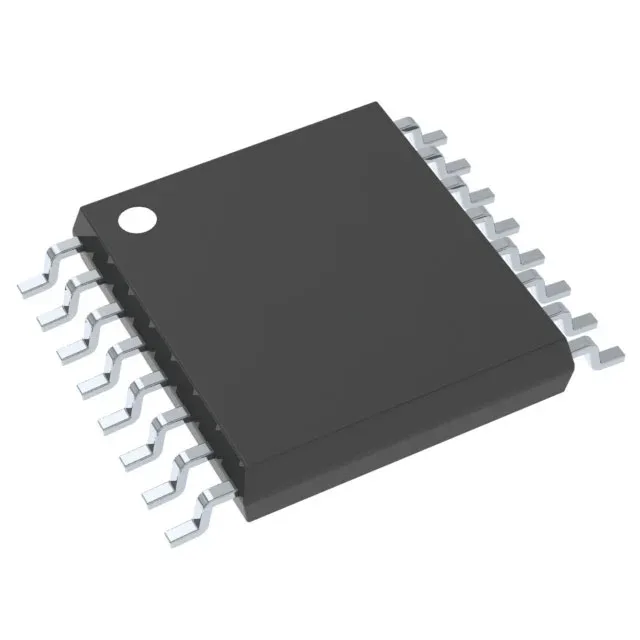
LVDS quad driver for high-speed serial links
It delivers 400 Mbps per channel across four independent driver channels, making it a fit for applications like flat-panel display interfaces, backplane data distribution, and camera-link cable extensions.
Each of the four drivers handles a 400 Mbps serial stream, which translates to a 200 MHz fundamental frequency on the differential pair. At this rate, the LVDS swing (typically 350 mV) keeps EMI low, but the PCB trace length and impedance control matter: a 100 Ω differential pair with proper termination at the receiver end maintains signal integrity over a few meters of twisted-pair cable. The driver's output current is matched to the standard LVDS load, so no external bias resistors are needed. If your system runs at lower rates (say 100 Mbps), the same part works with relaxed layout constraints.
Driver-only topology — plan for a companion receiver
With a 4/0 driver/receiver count, this device is a pure transmitter. The differential outputs (DOUT+ and DOUT−) must connect to an LVDS receiver such as the DS90LV048 or a compatible FPGA/ASIC LVDS input. The absence of on-chip receivers means the cable interface is simplex (one-way); for bidirectional links, a separate receiver pair or a transceiver like the DS90LV027 is needed.
The NOPB suffix confirms a lead-free (RoHS-compliant) finish, matching the requirements for EU and global markets. For dual-sourcing flexibility, the base DS90LV047 family includes several package and temperature variants — the ATMTC/NOPB is the 16-TSSOP industrial-grade option.