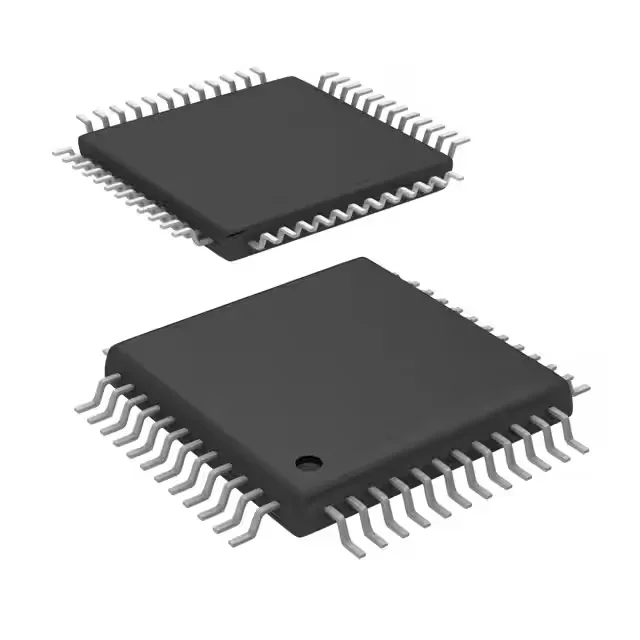
Four-channel LVDS reDriver with 1.5 Gbps per lane
The Texas Instruments DS90LV004TVS/NOPB is a four-channel LVDS buffer and reDriver designed to regenerate and condition high-speed serial signals over backplanes, cables, or long PCB traces. It accepts CML, LVDS, or LVPECL inputs and outputs clean LVDS levels, with output pre-emphasis to compensate for frequency-dependent loss in the interconnect. Each channel handles up to 1.5 Gbps, and the 2.0 ns propagation delay per channel is tight enough to fit into most timing budgets without requiring link-layer retiming. The 3.15 V to 3.45 V supply range ties it to a regulated 3.3 V rail — this isn't a wide-range part, so the power design needs good decoupling and a clean supply.
1.5 Gbps data rate and 2.0 ns delay — timing budget fit
At 1.5 Gbps per channel, this reDriver supports common serial standards like Gigabit Ethernet (1000BASE-X), Serial RapidIO, and CPRI line rates up to that speed. The 2.0 ns delay per channel is the propagation time through the device; in a multi-hop link (cable + backplane + reDriver + connector), you stack these delays and need to verify the total stays within the receiver's setup-and-hold window. The 3.5 pF input capacitance is low enough not to load the upstream driver excessively at these edge rates.
Output pre-emphasis — signal conditioning for lossy channels
The output pre-emphasis boosts the high-frequency content of the LVDS output, counteracting skin-effect and dielectric losses in long traces or cables. This is a practical feature when the interconnect loss exceeds a few dB at the Nyquist frequency (750 MHz for 1.5 Gbps NRZ). Without it, the eye would close at the far-end receiver. The pre-emphasis is fixed (not adaptive), so the board designer needs to set the correct amplitude based on the channel loss budget — the datasheet's application section covers the selection guidelines.
For a new design, this means standard lead times and no urgency to stockpile. The NOPB suffix indicates a lead (Pb)-free finish (NiPdAu), compliant with RoHS requirements — no separate lead-free version question needed.