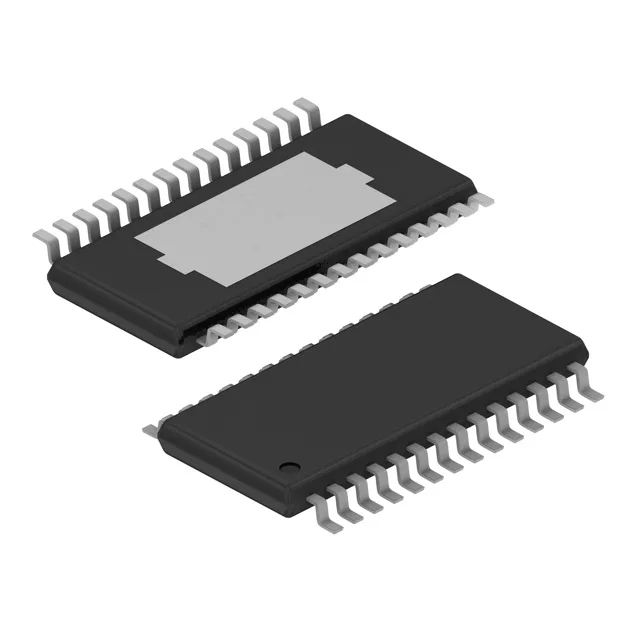
DRV8825PWPR

Texas Instruments

Texas Instruments DRV8825PWPR, fully integrated bipolar stepper motor driver, 8.2V–45V supply, 2.5A output, 1/32 microstepping, 28-PowerTSSOP (HTSSOP) package.

Texas Instruments DRV8825PWPR
Download datasheet (PDF)
[IN STOCK] In Stock: 6,639 pcs
$3.12/ pc

Volume pricing

Buy Now

MOQ 1 · Tape & Reel (TR); Cut Tape (CT) · RoHS · EIA-481 · DAP/DDP · T/T

Technical specifications

DRV8825PWPR specifications
Parameter / AttributeSpecification / Value
MountingSurface Mount
Motor type - stepperBipolar
Voltage - load8.2V ~ 45V
Supply voltage8.2V ~ 45V
Output current2.5A
InterfaceLogic
Operating temperature-40°C~150°C(TJ)
PackageTape & Reel (TR); Cut Tape (CT)
FunctionDriver - Fully Integrated, Control and Power Stage
TechnologyPower MOSFET
ApplicationsGeneral Purpose
Case28-PowerTSSOP (0.173\", 4.40mm Width)
Step resolution1 ~ 1/32
Output configurationHalf Bridge (4)
100% Footprint Match · Solder-Ready (No PCB Redesign Needed)

Need Stock or a Drop-in Second-Source for DRV8825PWPR?

Package: QFN-28 (die) / StepStick 16-pin module · Pin-compatible replacements with immediate Shenzhen spot stock

Footprint Match 95%
Supply Chain & Allocation Reality:

The StepStick footprint turned the A4988 into the default stepper driver of desktop 3D printers, CNC routers and camera rigs, and then into a family: the DRV8825 as the 1/32 upgrade in literally the same socket, the TMC2208 as the silent generation designed as an A4988 replacement. The socket is genuinely shared - the Vref arithmetic is not. Each generation sets motor current with a different formula (and different sense resistors on clone boards), so the classic failure of this family is a swap that fits perfectly and drives the motor at twice or half the intended current. This page exists to make the trimmer math explicit before the smoke.

Verified Pin-Compatible Replacements (3 verified alternatives)

DRV8825 TI / Pololu footprint boards StepStick 16-pin module (HTSSOP die)
Pin-to-Pin (Minor Clock/Init Tuning)
Availability & Target Pricing:

The 1/32 Upgrade in the Same Socket

Shenzhen Spot Stock (24-48h Dispatch)

Electrical & Core Specs:

Pin-for-pin the same board: 8.2V to 45V motor supply against the A4988 35V ceiling, up to 1/32 microstepping, and the same STEP/DIR/enable interface - but the jumper table and the Vref formula both move.

The maths is the headline: at the common 0.1 ohm sense resistor, A4988 trip current is Vref / (8 x Rs) while DRV8825 chopping current is Vref / (5 x Rs) - the same Vref commands roughly double the current on the 8825.

Compatibility & Drop-In Notes: The single most expensive habit in this hobby: dialing the remembered A4988 Vref onto a DRV8825. Recompute from the motor rating with the 8825 formula (Vref = Imax x 0.5 at 0.1 ohm), and re-derive steps/mm from the new jumper truth.
Package & Solder Footprint: Same 16-pin StepStick outline; the trimmer location and direction differ per board revision.
Shenzhen Warehouse Stock & MOQ: Stocked as boards and bare ICs; we ship the Vref formula sheet with every lot.
TMC2208 Trinamic / Analog Devices / StepStick boards StepStick 16-pin module (QFN die)
Pin-to-Pin (Minor Clock/Init Tuning)
Availability & Target Pricing:

The Silent Drop-In With Shifted Pins

Shenzhen Spot Stock (24-48h Dispatch)

Electrical & Core Specs:

The silence generation: StealthChop chopping removes the audible whine, 256 microsteps are interpolated internally from MS1/MS2 settings (2/4/8/16), and the datasheet-plus-AN-045 route treats it as a functional A4988 replacement.

4.75V to 36V motor supply; stand-alone current setting at the 0.11 ohm sense resistor lands at about Imax = Vref x 0.93, so Vref is numerically close to the motor current - a third formula in the same socket.

Compatibility & Drop-In Notes: In firmware the visible change is small (only MS1/MS2 are microstep inputs; most legacy 1/2, 1/4, 1/16 configs carry over) - the hardware pin map is the part that bites. Swap by mapping, never by position.
Package & Solder Footprint: Same StepStick outline; the added capacitor and the rotated orientation are board-level realities.
Shenzhen Warehouse Stock & MOQ: Stocked; boards and standalone ICs with the AN-045 mapping linked on the label.
A4988 (clone boards) Various (open market) StepStick 16-pin module
Functional Equivalent
Availability & Target Pricing:

The Clone Lottery - Read Rsense First

Shenzhen Spot Stock (24-48h Dispatch)

Electrical & Core Specs:

The unbranded A4988 boards that fill the market: the die is usually the real function, but the sense resistors decide the current math - Pololu originals historically at 0.05 ohm, most clones at 0.1 ohm, some at 0.2 ohm.

Same 8V to 35V operating class; the current you command at a given Vref changes with Rsense above.

Compatibility & Drop-In Notes: Bench procedure before trusting any clone: read the sense resistor marking (or measure), write the formula for that board on a sticker, and set current by the motor rating, never by a remembered voltage from another board.
Package & Solder Footprint: Same footprint; thermal quality (copper area, heatsink contact) varies widely between clones at the same claimed current.
Shenzhen Warehouse Stock & MOQ: We quote original and clone lanes separately with the Rsense value stated - the formula follows the board.
Buyer & Quality Checklist for Sourcing Alternatives
  • One socket, three formulas: A4988 trip current is Vref / (8 x Rs), DRV8825 is Vref / (5 x Rs), TMC2208 stand-alone is about Vref x 0.93 at its 0.11 ohm sense resistor. Dialing a remembered voltage from another generation is the classic burn.
  • Rsense is board-level, not chip-level: Pololu A4988 boards used 0.05 ohm historically, most clones 0.1 ohm, some 0.2 ohm. Read the sense resistor before writing any formula into the notebook.
  • The jumper truth changes with the generation: A4988 caps at 1/16 (all three high), DRV8825 makes all-high 1/32 - after any swap, steps-per-mm in the firmware must be recomputed or every dimension prints wrong.
  • Never adjust Vref with a metal screwdriver on a live board: measure at the trimmer with a meter, motor at standstill - a slipped probe across the driver is a dead driver and potentially a dead mainboard rail.
  • The StepStick footprint runs hot by design: the die rating is not the module rating in still air - 1A-class continuous with a heatsink and airflow is the realistic ceiling on most boards, and the stepper housing temperature is the honest gauge.
  • TMC2208 swaps are mapping exercises, not position swaps: the CP2 capacitor, ROSC to GND, and the inverted DIR (boards mount rotated) come from the AN-045 replacement guide - follow it pin by pin.
Frequently Asked Technical Questions

Q: Is the DRV8825 a drop-in replacement for the A4988?

A: The board and pins, yes; the settings, no. The jumper table moves (all-high is 1/32 against 1/16) and the Vref formula changes to Vref = Imax x 0.5 at 0.1 ohm against the A4988 equivalent of Imax x 0.8 - the same trimmer voltage commands about double the current.

Q: Can a TMC2208 replace an A4988?

A: It is designed as one (Analog Devices AN-045 details the pin-by-pin replacement), with caveats: an added capacitor on pin 5, ROSC tied to GND, MS3 and RESET repurposed, and DIR inverted - which is why the boards are often documented to mount rotated. Map the pins; never swap by position.

Q: Why did my stepper motor get hot after changing the driver board?

A: Current arithmetic. Each generation converts Vref to current with a different formula, and clone boards change the sense resistor underneath the formula. Recompute from the motor rating and the actual Rsense value before trusting any remembered Vref number.

Technical details

Supply range and output current — the BOM-fit anchors

The DRV8825PWPR runs from a single supply rail spanning 8.2V to 45V, which covers most common 12V, 24V, and 36V motor bus voltages without an extra regulator. The 2.5A continuous output per phase sets the thermal budget for the board — at full load the exposed pad on the 28-HTSSOP package needs a solid via array to the ground plane to keep junction temperature under the 150°C ceiling.

Microstepping resolution and drive architecture

Step resolution goes from full-step down to 1/32 microstep, controlled through the logic interface pins — no SPI or I2C bus required. The four half-bridge outputs drive a single bipolar stepper; the integrated power MOSFETs eliminate the need for external FETs and their associated gate-drive circuitry.

ROHS3 compliant. For a functional alternative with a lower supply minimum (3.0V) and 1.9A output, the DRV8811PWPR shares the same 28-HTSSOP footprint and half-bridge architecture.

Package and thermal layout

Tape & Reel and Cut Tape options are available.

DRV8825PWPR
[ALLOC] verified
Quote