What the 39 mT sensing range means for your current-sense or position-feedback loop
The DRV5056Z2QDBZR is a single-axis, ratiometric unipolar linear Hall sensor from Texas Instruments. Its 39 mT sensing range means the analog output voltage scales linearly from near-zero at 0 mT to the supply rail at 39 mT — a 0.1 mT change produces about 128 mV of swing on a 5 V supply, so a 12-bit ADC with a 5 V reference resolves roughly 0.01 mT per LSB. That resolution is adequate for closed-loop motor commutation feedback or linear position sensing over a few millimeters of travel. The 20 kHz bandwidth means the output tracks field changes up to 20 kHz — fast enough to capture the commutation edges in a 10,000 RPM motor with 12 poles (1 kHz fundamental) without aliasing into the control loop. The temperature compensation keeps the sensitivity drift below 0.1%/°C typical, so the calibration holds from a cold start at -40°C up to 125°C underhood ambient.
Supply voltage and output scaling — why the ADC reference must track the sensor rail
The output is ratiometric — at 0 mT the output sits at half the supply voltage, and at 39 mT it reaches the supply rail. The cleanest layout is to power both the sensor and the ADC from the same 5 V rail and let the ratiometric output cancel supply ripple common to both devices. For longer traces or higher capacitance, a unity-gain op-amp between the sensor output and the ADC input preserves the bandwidth.
Package and board-fit note for the SOT-23-3 footprint
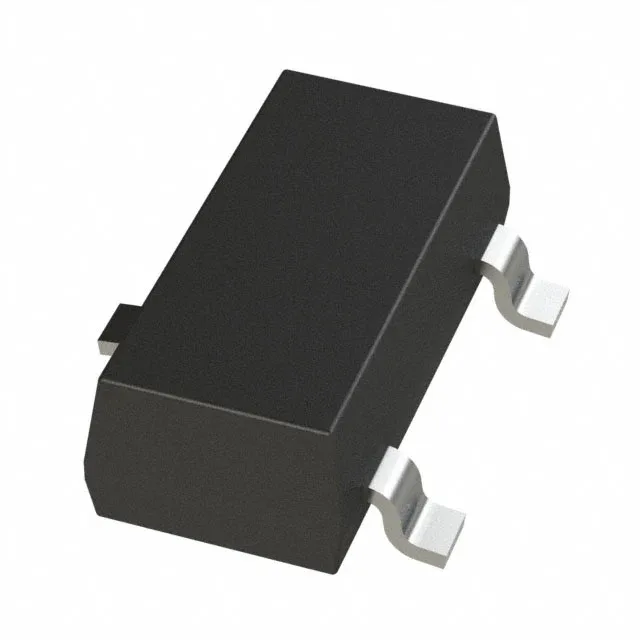
The DRV5056Z2QDBZR comes in a SOT-23-3 package (TO-236-3, SC-59 variant) with a 0.95 mm pin pitch. This is the same three-pin footprint used by many other linear Hall sensors (Allegro A1301, Melexis MLX90242), so a board designed for one of those parts can accept this TI device without a layout change — pin 1 is supply, pin 2 is ground, pin 3 is output. The tape-and-reel option is the standard 7-inch reel for SOT-23, 3000 units per reel.
The part is ROHS3 compliant — no exemptions, no restricted substances in the mold compound or leadframe.