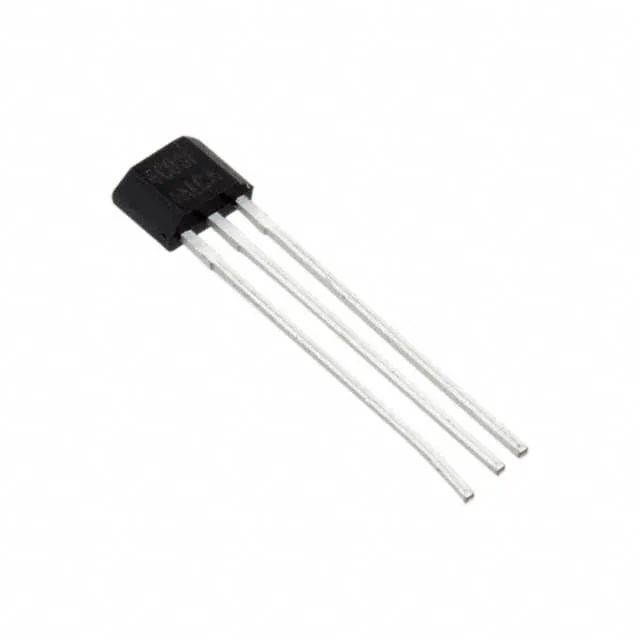
The DRV5056A4ELPGMQ1 is a single-axis linear Hall-effect sensor from Texas Instruments, part of the Automotive, AEC-Q100 series. It outputs an analog voltage proportional to the magnetic flux density perpendicular to the package face, with a sensing range of 158 mT. Supply current is 10 mA max, and the analog output can source up to 1 mA — enough to drive a typical microcontroller ADC pin directly. A 20 kHz bandwidth supports fast position, current, or proximity sensing in motor-control and actuator-feedback loops where the mechanical time constant is in the sub-millisecond range.
AEC-Q100 Grade 0 temperature range for under-hood duty
Qualified to AEC-Q100, the DRV5056A4ELPGMQ1 is rated for an operating ambient temperature of -40°C to 150°C. This Grade 0 temperature range covers under-hood and transmission-oil environments where the sensor sees sustained 125°C plus transient peaks. The TO-92-3 through-hole package is a standard three-lead footprint. For automotive PCB layouts, the lead spacing and body dimensions match existing Hall-sensor land patterns, simplifying a drop-in replacement or a first-design BOM.