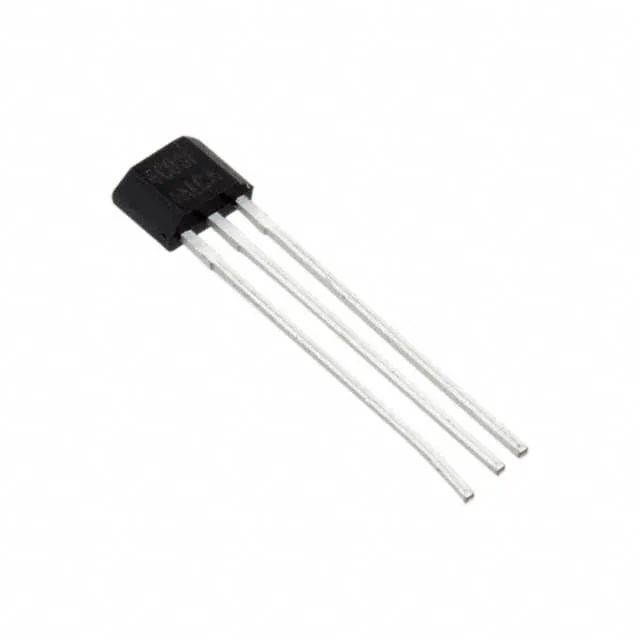
39 mT sensing range and 20 kHz bandwidth for position and current sensing
The DRV5056A2ELPGMQ1 is a single-axis linear Hall-effect sensor from Texas Instruments, part of the Automotive AEC-Q100 series. It detects magnetic flux density up to 39 mT and outputs a proportional analog voltage, making it suitable for rotor position, linear displacement, and current-sense applications in powertrain and chassis systems. The 20 kHz bandwidth captures fast-changing fields — adequate for monitoring gear teeth or wheel speed at high RPM where a lower-bandwidth sensor would alias the signal.
AEC-Q100 qualification and 150°C operating ceiling
The AEC-Q100 Grade 0 qualification covers the reliability stress tests (HTOL, HBM, CDM) required for safety-critical automotive ECUs. Temperature compensation circuitry (listed as a feature) stabilises the output sensitivity across the full range — the offset drift stays within the datasheet limits without an external thermistor lookup table.
Supply flexibility and output drive
The 10 mA max supply current is low enough to run from a regulated sensor rail shared with other Hall devices. The analog output drives up to 1 mA into the ADC input — enough for most microcontroller SAR ADCs without a buffer. The TO-92-3 through-hole package (short body variant) is the same footprint used in decades of Hall-effect sensors, so it drops into existing PCB layouts without a board spin. The package is ROHS3 compliant.
Active production and sourcing posture
No pin-compatible second source or official cross-reference is maintained by TI for this specific variant. The AEC-Q100 qualification and the 39 mT sensitivity range are the primary selection gates for the BOM line.