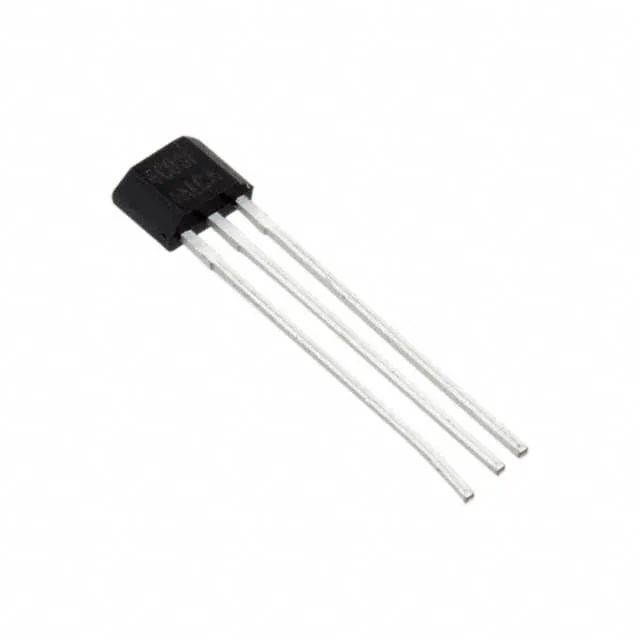
What the wide supply range and ±9 mT range mean for your BOM
The DRV5053VAQLPGM is a single-axis linear Hall-effect sensor from Texas Instruments that outputs an analog voltage proportional to the magnetic flux density. Its supply range of 2.5 V to 38 V lets it run directly off a 12 V or 24 V automotive rail, a 5 V logic supply, or a 3.3 V MCU rail — no dedicated regulator needed, which simplifies the power tree and saves a BOM line. The ±9 mT sensing range sets the magnetic budget for the air gap and magnet selection. At a 20 kHz bandwidth, the sensor can track motor-commutation edges and vibration signatures up to the audible range, making it suitable for position feedback in brushless DC motors and linear actuator stroke sensing.
Output drive and supply current — what the numbers actually limit
Maximum output current is 2.3 mA. This is enough to drive the analog input of a typical MCU ADC (input impedance >10 kΩ) or an op-amp buffer, but it will not directly drive a relay coil or a heavy capacitive load. The maximum supply current is 3.6 mA — the total current draw from the 2.5 V to 38 V rail, which is low enough to keep the thermal budget negligible in a sealed enclosure. Temperature compensation is built in — the output voltage drift over temperature is trimmed internally, so the system does not need a separate temperature sensor or software calibration for the magnetic path. This reduces firmware complexity and calibration time during production.
Texas Instruments continues to manufacture this part in the TO-92-3 package. The base product number is DRV5053, which covers multiple sensitivity and package variants — the VAQ variant is the ±9 mT, analog-output, through-hole version. ROHS3 compliant — no exemption issues for EU or California market shipments. The part is available in Cut Tape (CT) and Tape & Box (TB) packaging, which covers both prototyping and production reel quantities.