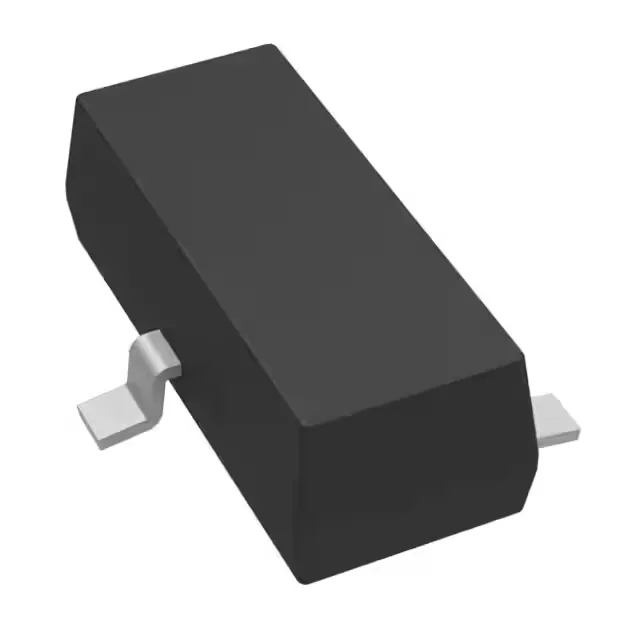
The DRV5053PAQDBZR is a linear Hall-effect sensor from Texas Instruments that outputs an analog voltage proportional to the applied magnetic field. The single-axis sensor measures fields up to ±35 mT with a 20 kHz bandwidth, which is fast enough to capture rotor position in a motor spinning at several thousand RPM or to sense current in a switching power supply running at hundreds of kilohertz. The analog output is ratiometric to the supply — the zero-field output sits at half Vcc.
Error budget and temperature stability
For a current-sense application, the total error at the ADC input is the stack of the sensor's offset drift, sensitivity drift, and the ADC's own gain error — the temperature compensation keeps the sensitivity shift within a few percent over the full automotive temperature band. The maximum supply current is 3.6 mA, and the output can source or sink up to 2.3 mA. This output drive is sufficient to directly feed the analog input of a typical automotive MCU's ADC without a buffer, provided the ADC's sampling capacitor is small enough that the settling time stays within the conversion window.
Housed in a three-pin SOT-23-3 package (supplier device package SOT-23-3, also known as TO-236-3 or SC-59), the footprint is compact and requires no exposed thermal pad. The pinout is Vcc, GND, and output — a single 0.1 µF decoupling capacitor between Vcc and GND close to the pins is the only external component needed. Available in cut tape as well as full reels.
Lifecycle and sourcing posture
It is suitable for new designs and can be specified into production BOMs without a last-time-buy risk. No stock-holding claim is made — each order is quoted to the BOM line.