Single-axis analog Hall sensor for 150°C automotive environments
The DRV5053PAEDBZRQ1 is a single-axis linear Hall-effect sensor from Texas Instruments that outputs an analog voltage proportional to the magnetic flux density along its sensitive axis. Rated for ±35 mT sensing range and 20 kHz bandwidth, it is fast enough to track rotor position in a brushless DC motor at several thousand RPM.
What the 20 kHz bandwidth and ±35 mT range mean for the BOM
The 20 kHz bandwidth supports position feedback loops with update rates up to 20,000 samples per second — enough for commutation in a 12-pole motor spinning at 100,000 RPM (where the electrical frequency is 10 kHz). The ±35 mT range covers the field strength from a standard N35-grade neodymium magnet at a 2–5 mm air gap, so the sensor works with common actuator magnets without a custom pole piece. Output is an analog voltage ratiometric to the supply — the zero-field output sits at half the supply voltage, and the sensitivity scales with Vcc. This means the ADC reference can share the same supply rail and still get a ratiometric reading, cancelling low-frequency supply noise.
Active production — sourcing against the BOM line
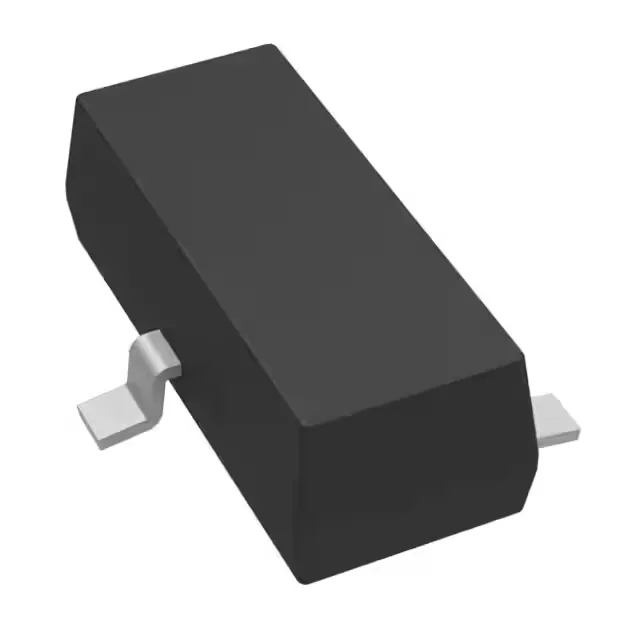
The SOT-23-3 package is a standard three-pin footprint shared by many linear Hall sensors — if allocation becomes an issue, pin-compatible alternatives exist in the same DRV5053 family (different sensitivity grades) and from other vendors, though the AEC-Q100 Grade 0 temperature range narrows the field.