Key parametrics and what they mean for the BOM
The DRV5053OAEDBZRQ1 is a single-axis linear Hall effect sensor from Texas Instruments, part of the DRV5053 family. Its ±73 mT sensing range covers the magnetic flux densities typical of permanent-magnet position sensing in brushless DC motors and linear actuators — the output voltage swings proportionally across the full 2.7 V to 38 V supply range. A 20 kHz bandwidth means the sensor tracks rotor position changes at speeds up to 20,000 electrical cycles per second — sufficient for the commutation loop in a 12-pole motor spinning at 100,000 RPM. The analog voltage output connects directly to a 12-bit ADC without external signal conditioning, keeping the BOM count low.
Automotive-grade deployment and temperature range
AEC-Q100 qualification (Grade 0) certifies the sensor for -40°C to 150°C ambient operation — the full under-hood temperature envelope including the engine block and transmission housing. The temperature-compensated design holds the sensitivity drift within the datasheet limits across this band, so the ADC reading at 150°C still maps to the same magnetic flux as at 25°C. The 3.6 mA max supply current is negligible in the system power budget; a 100 mW LDO can power it alongside the MCU and CAN transceiver.
Package, footprint, and board integration
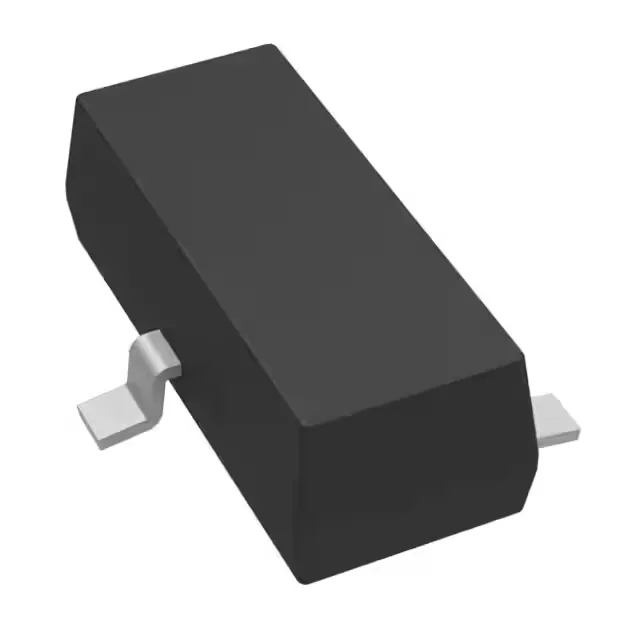
Housed in a standard SOT-23-3 (TO-236-3, SC-59) surface-mount package, the sensor occupies a 2.9 mm × 1.3 mm footprint — small enough to place at the air gap of a stator tooth or inside a motor endbell. The three pins (VCC, GND, VOUT) route directly to the MCU ADC pin with a 100 nF decoupling cap at the VCC pin; no external gain stage or filter is required for most applications.