What the ±18mT range and 20 kHz bandwidth mean on the bench
The DRV5053EAQLPGQ1 is a single-axis linear Hall sensor that outputs an analog voltage proportional to the magnetic flux density it sees. The ±18 mT sensing range sets the linear window — within that field strength the output voltage swings between the supply rails without saturating. Outside that range the output clips, which tells you the magnet gap or pole strength needs adjusting. The 20 kHz bandwidth means the sensor can track magnetic fields changing at up to 20,000 cycles per second. For a rotating target like a gear tooth or a motor shaft, that translates to detecting edges at high RPM without the output lagging behind the mechanical event.
The 2.7 V to 38 V supply range covers the full automotive battery envelope: a cold-crank dip down to 2.7 V won't brown out the sensor, and a 38 V load-dump transient won't blow the input stage. No external clamp is needed for most 12 V or 24 V systems. The temperature-compensated design keeps the output drift predictable across that span — the sensitivity shift stays within the datasheet limits so the downstream ADC doesn't need a wide calibration window.
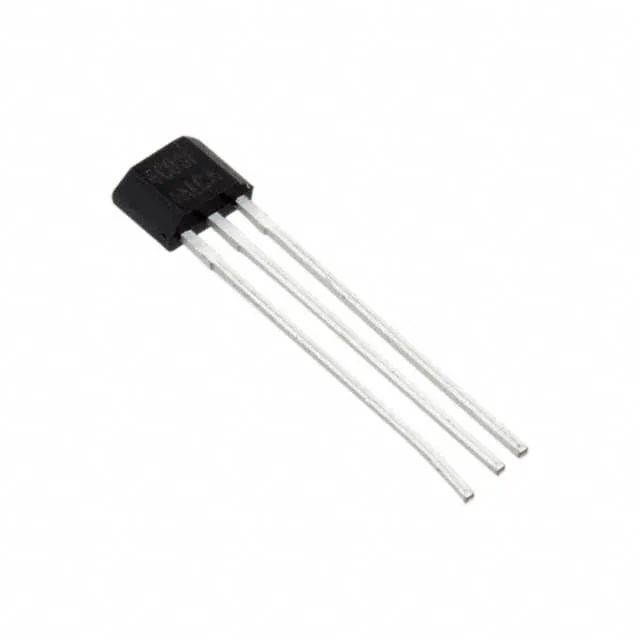
Through-hole TO-92-3 — a rework-friendly package
The TO-92-3 package is a three-lead through-hole format. The leads are 0.100-inch pitch, standard for breadboard prototyping and hand-soldering. On a repair bench, pulling a dead TO-92 and dropping in a replacement takes about 30 seconds with a desoldering iron — no hot-air profile, no paste stencil.
Active lifecycle and supply posture
It is a current-production part, sourced through authorized distribution.