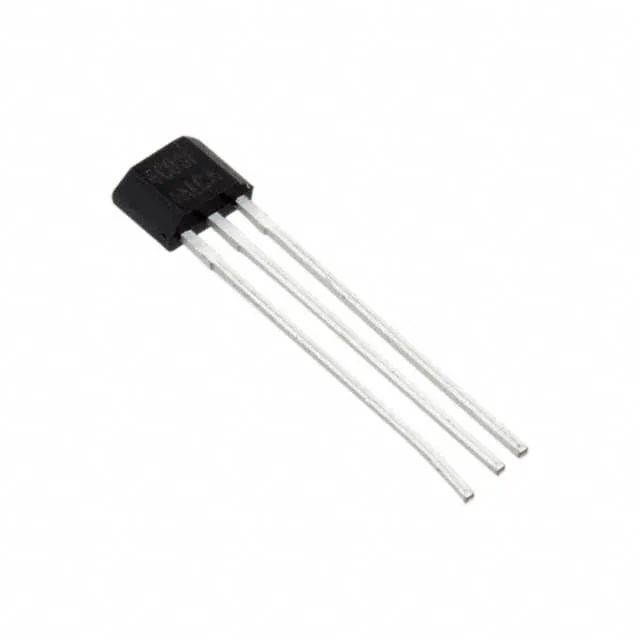
The DRV5053EAQLPGM is a single-axis, analog-output Hall-effect sensor from Texas Instruments, AEC-Q100 qualified for automotive environments. It outputs a voltage proportional to the magnetic flux density perpendicular to the package face, with a ±18 mT sensing range. The 20 kHz bandwidth supports fast-switching motor phases and vibration monitoring; the analog output connects directly to a 3.3V or 5V ADC without level shifting, because the supply rail (2.7V to 38V) can match the microcontroller's reference.
Supply voltage range and output drive
The 2.7V to 38V supply lets you run the sensor off a 5V or 12V automotive bus without an extra regulator. The 2.3 mA maximum output current is enough to drive a single ADC input or a low-impedance buffer; do not plan to source a relay or LED directly from the output pin. Supply current maxes at 3.6 mA, so the total sensor load on the rail stays under 4 mA — a detail that matters when budgeting the 5V standby current for a body-control module.
The TO-92-3 through-hole package is a three-lead, 2.54 mm pitch footprint — hand-solderable and board-inspectable without X-ray. The short-body variant (TO-92-3 Short Body) saves 1.5 mm of height over the long-lead version, which matters when the sensor sits on a daughter card inside a sealed housing.
The base product number DRV5053 covers multiple sensitivity variants in the same TO-92-3 footprint, so if the ±18 mT range is too narrow or too wide, a sibling code drops in without a board spin. ROHS3 compliant. No stock-holding claim; each lot date-code traced back to the authorized TI channel before shipment.