What the ±18 mT range and 20 kHz bandwidth mean for your application
The DRV5053EAEDBZRQ1 is a single-axis linear Hall sensor that outputs an analog voltage proportional to the magnetic flux density it sees. Its ±18 mT sensing range covers moderate-strength magnetic fields — think position sensing in a linear actuator or current sensing through a ferrite core where the field stays under 18 mT. The 20 kHz bandwidth means it can track fast-changing fields, like those from a PWM-driven solenoid or a spinning motor pole, without the output lagging behind the mechanical event. The analog voltage output (2.3 mA max drive) connects directly to an ADC on your microcontroller — no external signal conditioning needed for most 12-bit or 10-bit inputs. The 2.7 V to 38 V supply range is unusually wide for a Hall sensor: you can run it off a 3.3 V logic rail or tap into a 24 V industrial supply without a separate regulator. That 38 V ceiling also gives headroom against transients on an automotive 12 V bus.
Automotive temperature grade and AEC-Q100 qualification
The 150°C upper limit puts it in the engine-bay or transmission-oil temperature band, not just the cabin. Temperature compensation is built into the die, so the output voltage drift over temperature stays within the datasheet limits without a software lookup table.
Package and board-fit for the SOT-23-3
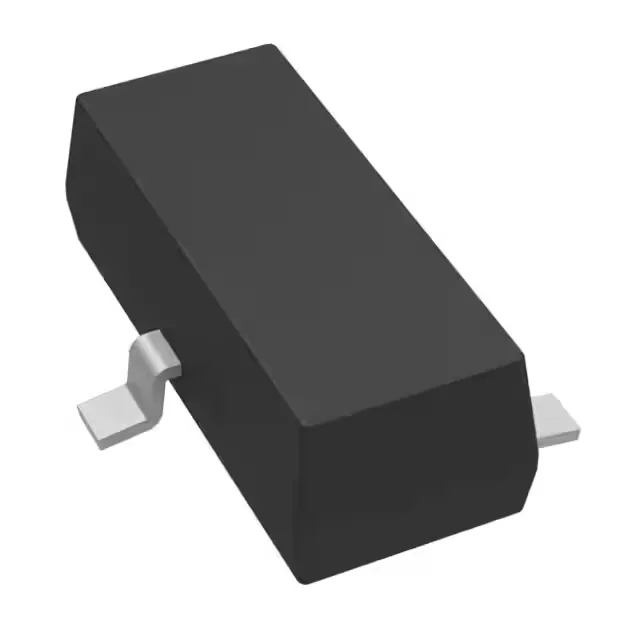
The SOT-23-3 package (TO-236-3 / SC-59) is a three-pin surface-mount footprint that hand-solders easily with a fine-tip iron or hot-air rework station. No thermal pad, no exposed paddle — just the supply, ground, and output pins. The 3.6 mA max supply current keeps self-heating negligible, so the sensor's own temperature rise doesn't shift the magnetic reading.