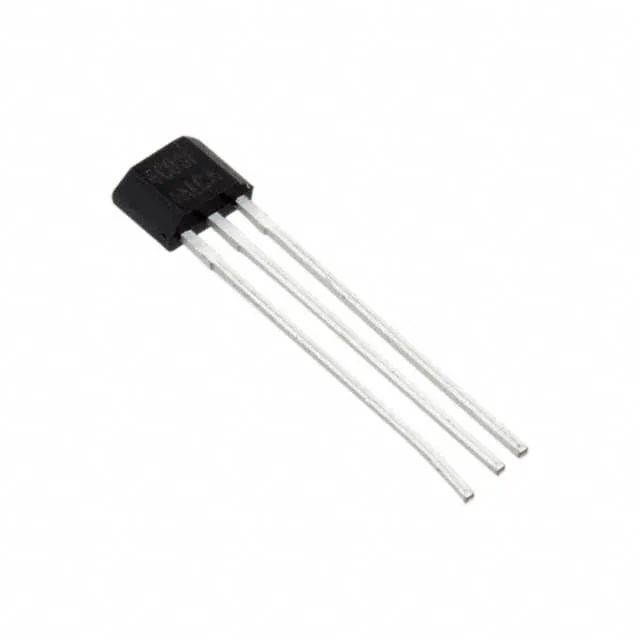
What this unipolar Hall switch does on your board
The DRV5032FDLPGM is a unipolar Hall-effect switch from Texas Instruments — it outputs a logic-low when a magnetic field of the correct polarity exceeds the ±4.8 mT trip threshold, and releases (goes high) when the field drops below ±3 mT. The push-pull output means you can drive a microcontroller input or a small load directly without an external pull-up resistor. The 3.5 µA max supply current makes it a strong candidate for battery-powered or energy-harvesting designs where every microamp counts.
TO-92-3 package — breadboard and hand-solder friendly
The through-hole TO-92-3 short-body package (TO-226-3) is about as maker-friendly as it gets. Three pins on 0.1-inch pitch, no reflow profile needed, and it plugs straight into a breadboard or perfboard. If you are prototyping a magnetic latch, a position sensor, or a contactless switch for a weekend project, this is the package you want. The temperature-compensated feature keeps the trip point stable across that range — the switch threshold does not drift with the weather.
The base product number is DRV5032, so other variants in the family (different sensitivity grades, output types, or packages) share the same core design. If you need a different sensitivity or an SMD package, the DRV5032 family has options — but the FDLPGM variant is the through-hole unipolar switch with the ±4.8 mT trip window.