What the sensing thresholds mean for your magnetic design
The DRV5032DUDMRT switches output state when the magnetic flux density crosses ±3.9mT (trip point) and resets at ±3.5mT (release point) — a 0.4mT hysteresis that prevents chatter from mechanical vibration or field ripple. Because it detects both North and South poles, you can trigger it with either magnet orientation, simplifying mechanical alignment in a housing or on a rotating shaft.
Power budget and supply flexibility
Drawing just 3.5µA max from a 1.65V to 5.5V rail, this sensor can run directly off a coin cell or a 3.3V LDO without a separate power switch — useful for battery-operated proximity or position sensing where every microamp matters. The push-pull output drives logic inputs directly without an external pull-up resistor, saving one component and a trace on the board.
Package and board-fit for tight layouts
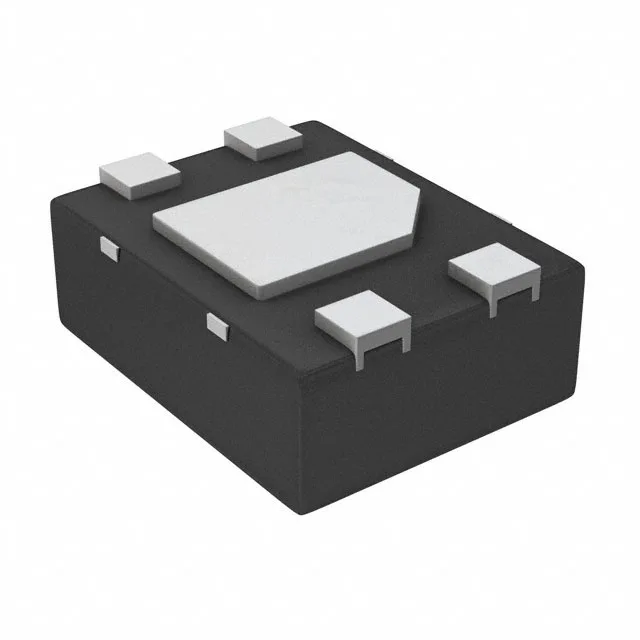
Housed in a 4-X2SON (1.1x1.4mm) package with an exposed pad, this part fits under a small sensor module or on the edge of a PCB where board real estate is at a premium. Surface-mount assembly with the exposed pad helps thermal management if the sensor is near a warm component, though at 3.5µA dissipation is negligible.