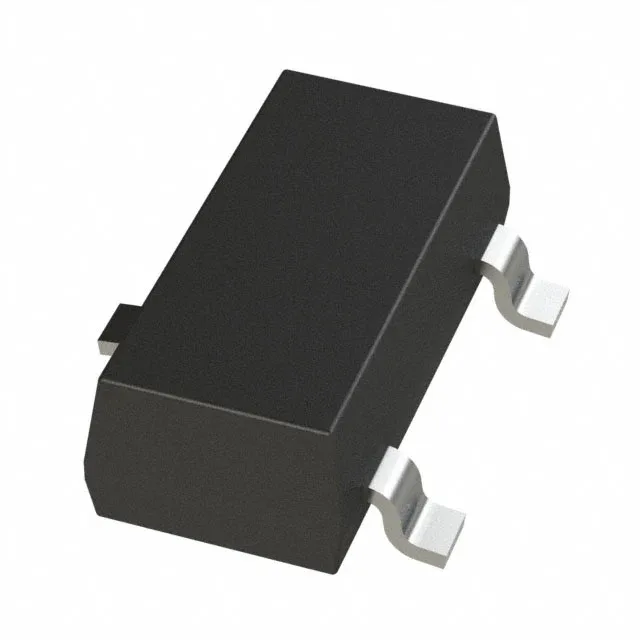
Hall switch with a tight window and a very low power budget
The DRV5032DUDBZT is a unipolar Hall-effect switch from Texas Instruments that detects a magnetic field of either polarity — north or south — and switches its push-pull output when the field crosses ±3.9 mT, releasing at ±3.5 mT. That 0.4 mT hysteresis prevents chatter at the switching threshold, which matters when the sensor is near a magnet that moves slowly or vibrates.
What the supply current and voltage mean for a battery-powered design
Drawing a maximum of 3.5 µA from a supply that can drop to 1.65 V, this part runs directly off a single alkaline cell or a coin cell without a regulator — the sensor's own quiescent current is well below the battery's self-discharge rate, so it adds negligible drain in a system that sleeps most of the time and wakes to check a magnetic latch or a reed-switch replacement.
Package and board-fit: SOT-23-3 with tape-and-reel options
Housed in a standard SOT-23-3 (TO-236-3 / SC-59) package, the footprint matches the common small-signal transistor land pattern — three pads, 1.9 mm pitch, 2.9 mm body length.