What this unipolar Hall switch does on the board
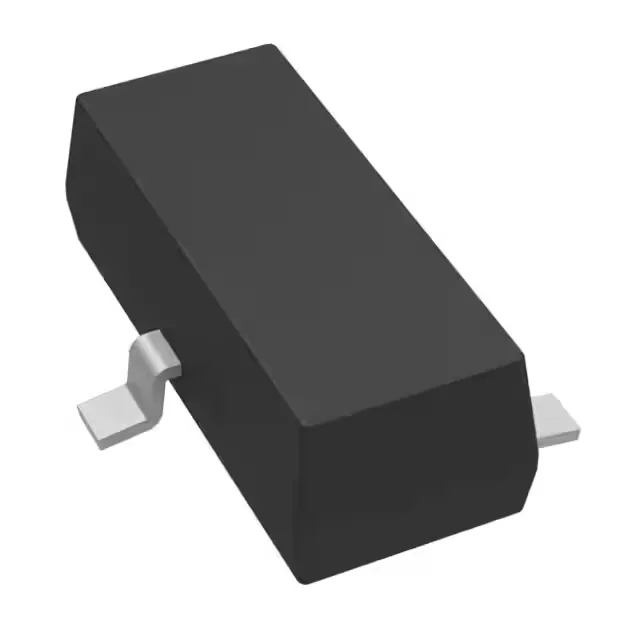
The Texas Instruments DRV5023AJQDBZT is a unipolar Hall-effect switch that activates when a south-pole magnetic field of sufficient strength is present. It is a member of the DRV5023 family, packaged in a three-pin SOT-23-3 for surface-mount assembly. The device switches its open-drain output low when the magnetic flux density exceeds the ±12 mT trip point (BOP) and releases (returns high) when the field drops below ±1 mT (BRP). This hysteresis — 11 mT typical — prevents output chatter at the switching threshold.
Sensing thresholds and temperature stability
The temperature-compensated design keeps the magnetic thresholds stable as the silicon heats up — important for applications where the sensor sits near a motor winding or exhaust path that pushes junction temperature well above 85°C. Because it responds only to a south pole, the sensor ignores north-pole fields that might be present from nearby magnets or stray fields in the assembly. This polarity-specific switching simplifies system-level magnetic design — you do not need to shield the sensor from the wrong pole.
Output drive and supply considerations
The open-drain output sinks up to 30 mA maximum, with a typical switching current of 2.7 mA. The SOT-23-3 footprint is a standard three-lead package with 0.95 mm pitch — the same land pattern used by many small-signal transistors and diodes, so the PCB layout is straightforward and the sensor can be placed close to the magnet target without a large pad footprint.