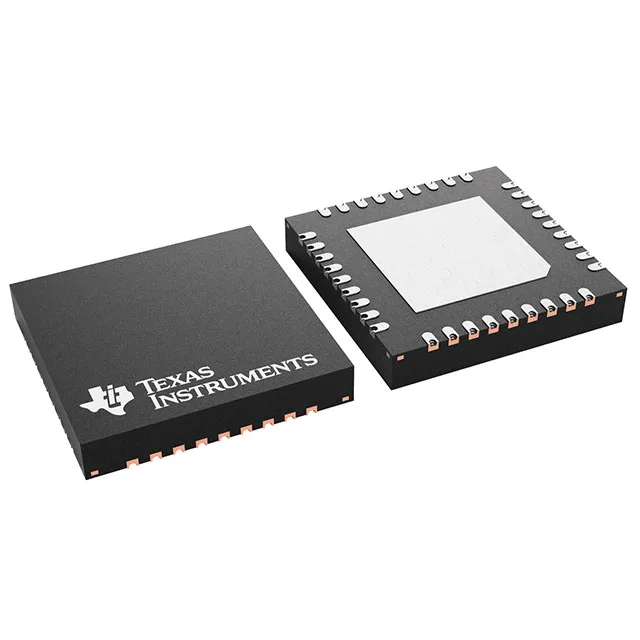
Automotive Ethernet PHY for the 125°C under-hood zone
The DP83TC812SRHARQ1 is an automotive-grade Ethernet transceiver from Texas Instruments, rated for -40°C to 125°C ambient — the full under-hood temperature band where a 105°C summer soak still leaves margin. AEC-Q100 qualification means the device passed the reliability stress, temperature cycling, and ESD tests required for engine-bay or chassis-domain deployment. It supports both full and half duplex operation over standard Ethernet, with 4 drivers and 4 receivers on-chip — enough for a multi-drop bus topology or redundant link paths in a safety-critical network.
Power rail and supply tolerance for 3.3V systems
The supply range is 2.97V to 3.63V — a tight 3.3V nominal rail with ±10% tolerance. This means the transceiver sits on the same 3.3V plane as the host MAC or switch ASIC without a separate regulator, but the rail must stay within 10% under load transient; a 3.3V rail that dips to 2.8V on a 1A step will drop the transceiver out of spec. The 36-VQFN package (6x6 mm) with exposed pad and wettable flank allows automatic optical inspection (AOI) of the solder joints — a requirement for automotive production lines that cannot rely on X-ray for every joint. The exposed pad must be soldered to a thermal via array under the package to keep the junction temperature below the 125°C ceiling at full line-rate traffic.