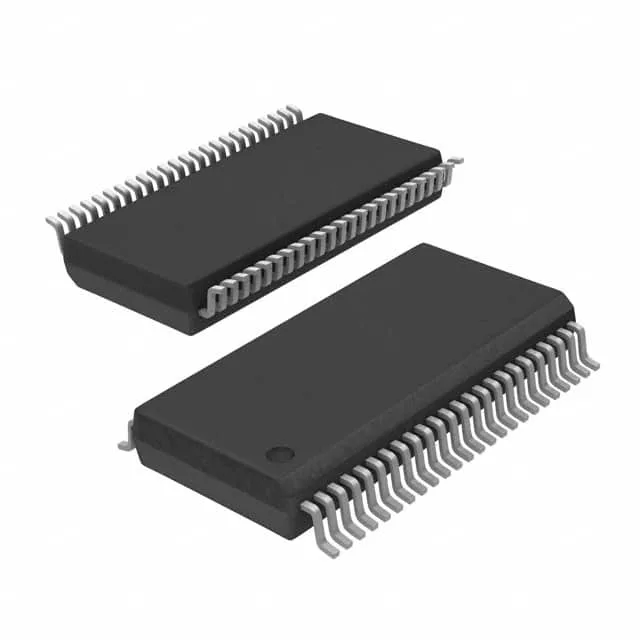
Quad 16-bit DAC with buffered voltage output
The DAC7634E packs four 16-bit digital-to-analog converters in a single 48-SSOP package, each with a buffered voltage output. The R-2R architecture gives monotonic performance — the output moves in one direction as the code increases, which matters when the DAC is driving a closed-loop system like a servo valve or a programmable power supply where a non-monotonic step could cause oscillation. Settling to within 1 LSB takes 10 µs typical, so the update rate per channel is roughly 100 kSPS. The SPI interface keeps the pin count low — three wires (SCLK, DIN, CS) plus a shared load-dac strobe handle all four channels.
Accuracy and reference: what the INL/DNL numbers mean
Integral non-linearity is ±3 LSB maximum, differential non-linearity ±2 LSB maximum. At 16 bits, 1 LSB is 15.26 ppm of full scale. ±3 LSB INL means the worst-case deviation from a straight line is about 46 ppm of full scale — that is the accuracy floor for the transfer function. For a calibration technician, this sets the limit on how tight the system can be trimmed without a lookup table. The reference is external, so the absolute accuracy of the output depends entirely on the voltage reference you supply. A 2.5 V reference with ±0.05% initial accuracy and 5 ppm/°C drift will dominate the error budget, not the DAC itself. The analog supply rails are ±5 V, giving a bipolar output range up to ±Vref — useful for industrial signal chains that need to swing through zero.
Package, temperature grade, and board integration
The 48-BSSOP body is 7.50 mm wide, 0.295-inch pitch — a standard SSOP footprint. The surface-mount package is suited for reflow assembly; the Tube shipping format means the parts arrive in anti-static tubes, not tape-and-reel, so plan for pick-and-place feeder changeover if your line is set up for reels.