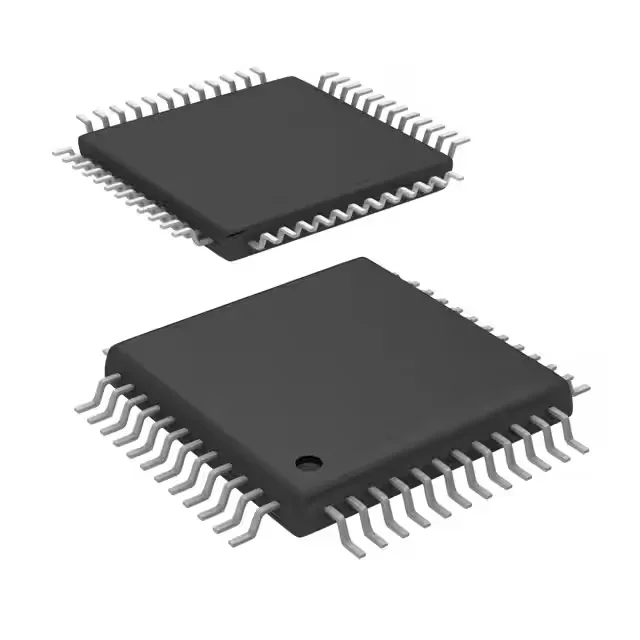
14-bit dual DAC with 20 ns settling — the speed and channel count for waveform synthesis
The DAC5672AIPFB is a 14-bit, dual-channel, current-output digital-to-analog converter from Texas Instruments. Its 20 ns typical settling time and parallel data interface make it suited for high-speed waveform generation, direct digital synthesis, and arbitrary waveform playback in communications test equipment and industrial signal chains. The differential current output (Current - Unbuffered architecture) delivers the signal directly to an external load or I-V converter, keeping the signal path clean and the settling fast — the 20 ns figure is the time to settle within ±0.1% of final value after a full-scale transition.
The exposed pad on the underside provides a low-impedance thermal path to the PCB ground plane — critical for dissipating the heat from the current-source output stage when driving low-impedance loads at full update rate. The reference type is selectable between an internal bandgap reference and an external reference input. Using the internal reference simplifies the BOM by one component; using an external reference lets the system designer inject a lower-noise or ratiometric reference for applications where the internal reference's noise floor would limit the SNR at the converter's output.
Linearity and output architecture — what the INL/DNL numbers mean for signal fidelity
The integral non-linearity (INL) is ±1.1 LSB typical, and the differential non-linearity (DNL) is ±0.75 LSB typical. For a 14-bit converter, ±1 LSB INL means the transfer curve deviates from an ideal straight line by less than one part in 16,384 — this is the static linearity that determines the spurious-free dynamic range (SFDR) in a sine-wave reconstruction application. A DNL within ±0.75 LSB guarantees no missing codes at 14-bit resolution, so the output code sequence is monotonic across the full range. The current-source architecture with differential output means the DAC's output is a pair of complementary currents (Iout and Iout-bar). This cancels common-mode noise and doubles the signal swing into a differential load — a transformer-coupled output to a 50 Ω system is a typical implementation for communications transmit chains.