10-bit string DAC with I²C — parametric fit
The DAC53401DSGRQ1 is a single-channel 10-bit buffered voltage-output DAC from TI's automotive AEC-Q100 series. Its string-DAC architecture guarantees monotonicity — the output never steps backward as the code increments, which matters for closed-loop control and trim applications where a non-monotonic glitch could latch a servo or mis-set a bias point. Settling time is 12 µs typical to ±0.5 LSB, fast enough for most sensor calibration, set-point, and bias-adjustment loops running below 80 kHz update rates. The I²C interface keeps pin count low — only two bus lines plus the supply rails — which helps on space-constrained automotive ECU boards.
Dual supply rails and temperature range
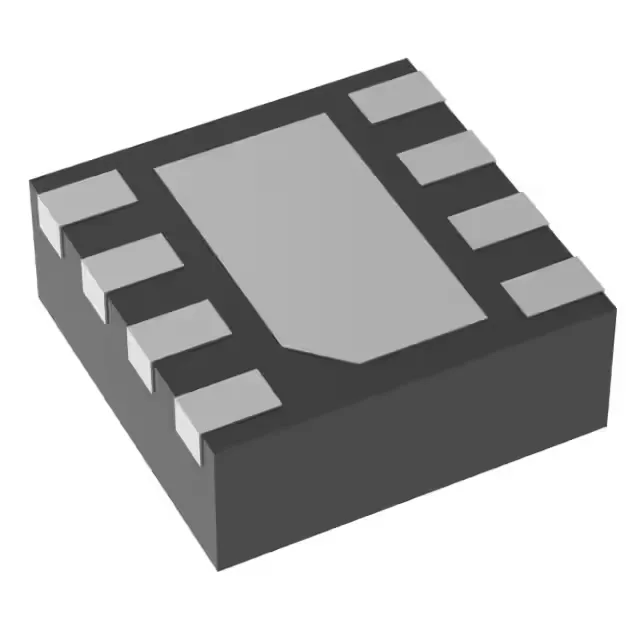
The digital supply is separate at 0.4 V to 1.62 V, letting the I²C bus operate at 1.2 V or 1.8 V logic levels without a level shifter — common in modern automotive MCU domains. The 8-WSON (2x2 mm) package with exposed pad pulls heat into the PCB copper; the pad should be soldered to a thermal land on the board, not left floating, to keep junction temperature within limits under continuous load. INL and DNL are both ±1 LSB maximum, meaning the DAC is monotonic and the transfer curve stays within one LSB of ideal across all codes. For a 10-bit DAC with a 5 V reference, that is about 4.9 mV of integral error — acceptable for most trim and bias applications, though a precision reference external to the package will tighten the absolute accuracy.