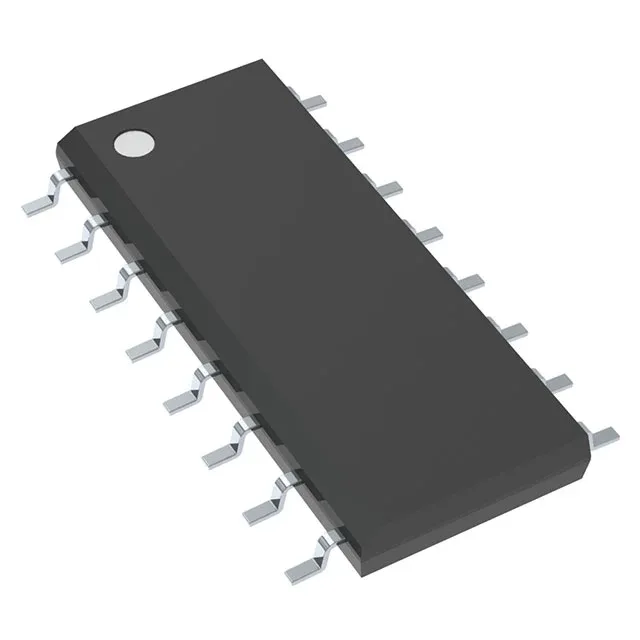
Texas Instruments CD74HCT109M — Logic ICs

CD74HCT109M JK Flip-Flop, 54 MHz, -55 to 125°C, 16-SOIC

MPNCD74HCT109M
End of Life

Texas Instruments 74HCT series JK flip-flop, dual element, 1-bit per element, positive-edge triggered, complementary outputs, set/preset and reset, 54 MHz clock, 4.5V to 5.5V supply, -55°C to 125°C, 16-SOIC surface mount.

$1.13Ref. price · indicative, final on quote
Packaging16-SOIC (0.154", 3.90mm Width)
RoHSROHS3 Compliant
Series74HCT
Independent supplier — new & surplus stockAuthenticity-screened · ESD-safe packingListing updated Aug 2026

Specifications

CD74HCT109M specifications
ParameterValue
TypeJK Type
Series74HCT
Output typeComplementary
Trigger typePositive Edge
MountingSurface Mount
Supply voltage4.5V ~ 5.5V
Current - quiescent4 µA
Current - output high, low4mA, 4mA
Clock frequency54 MHz
Operating temperature-55°C ~ 125°C (TA)
PackageTube
FunctionSet(Preset) and Reset
Case16-SOIC (0.154\", 3.90mm Width)
Input capacitance10 pF
Number of elements2
Number of bits per element1
Max propagation delay @ v, max CL40ns @ 4.5V, 50pF

Product details

Dual JK flip-flop with set and reset — the field-replaceable workhorse

Clock frequency hits 54 MHz, with a propagation delay of 40 ns at 4.5V into a 50 pF load. Quiescent supply current is a lean 4 µA, and each output can source or sink 4 mA — enough to drive standard CMOS logic inputs or a single low-current LED indicator on a panel.

Output drive is 4 mA per pin. Input capacitance is 10 pF per the datasheet — factor that into your clock-line loading if you are daisy-chaining multiple flip-flops on a single clock trace. At 54 MHz, a few extra pF of trace + input capacitance can start to round the clock edges.

The 16-SOIC package is surface-mount, so it can be conformal-coated for humidity and vibration resistance. No lab bench needed to swap it — a standard soldering iron and a steady hand are enough for field replacement, though a hot-air station makes desoldering cleaner.

Frequently asked questions

Is CD74HCT109M obsolete or still active?

Active. The manufacturer lists it as current production, ROHS3 compliant, with no end-of-life notice. It is safe to design into new BOMs.

Does CD74HCT109M work with 3.3V logic?

No. The supply range is 4.5V to 5.5V, and HCT inputs are TTL-threshold. A 3.3V CMOS output driving HIGH may not reach the ~2.0V V_IH(min) reliably. Use a level translator or run the flip-flop at 5V with 3.3V-tolerant inputs through a buffer.

What is the difference between CD74HCT109M and CD74HC109M?

The HCT version (this part) has TTL-compatible input thresholds, so it can be driven directly by 74LS or 74S outputs. The HC version uses CMOS thresholds and may not recognize a TTL-level HIGH as a valid logic 1. Both run on 2V to 6V supply, but HCT is the better choice for mixed-technology 5V boards that include legacy bipolar logic.

What are equivalent replacements for CD74HCT109M?

No direct pin-compatible second source is listed in the manufacturer's cross-reference. The SN74LS175NS is a different function (quad D-type, not dual JK) and the DM7474N is a D-type, not a JK. For a true JK flip-flop in 16-SOIC with set/reset, the TI CD74HCT109M is the standard part. The 74HCT109 from other vendors (NXP, ON Semiconductor) may be functionally equivalent, but verify pinout and timing before substituting.

Is CD74HCT109M compatible with 5V logic systems?

Yes. It is designed for 4.5V to 5.5V supply and its inputs are TTL-compatible, so it works directly with 5V CMOS, 74LS, 74S, and 74HCT logic families. Outputs swing rail-to-rail, so they drive 5V CMOS inputs cleanly.