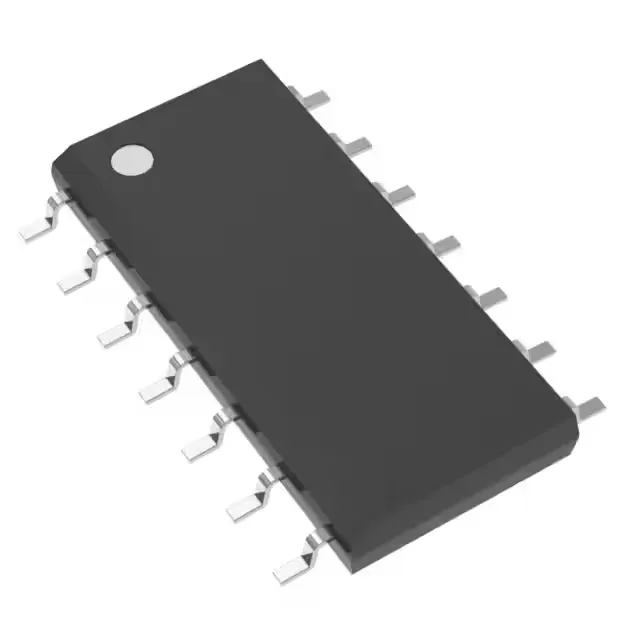
14-SOIC footprint and board integration
The CD74HC73M comes in a 14-SOIC (0.154", 3.90mm width) surface-mount package, supplier device package 14-SOIC. The 1.27 mm pitch is board-friendly — a two-layer PCB with 0.25 mm traces routes the six active signal lines (CLK, CLR, J, K, Q, Q̅) plus VCC and GND without via congestion under the body. Input capacitance is 10 pF per pin, so the clock line sees 20 pF loading from both flip-flops. A 60 MHz clock with 5 ns rise time into that load needs a source impedance under 25 Ω to keep the edge clean at the negative-edge trigger threshold.
What the 60 MHz clock and 28 ns propagation delay mean for timing closure
Maximum clock frequency is 60 MHz, and the max propagation delay is 28 ns at 6 V supply with 50 pF load. That delay is the time from the negative clock edge to the output settling — at 60 MHz the clock period is 16.7 ns, so the propagation delay exceeds the period. This means the flip-flop cannot toggle at 60 MHz in a synchronous pipeline where the output must be valid before the next clock edge; 60 MHz is the toggle frequency for the flip-flop itself, but the usable system clock in a synchronous design will be lower, governed by the propagation delay plus setup time of the next stage. The 28 ns delay is specified at 6 V and 50 pF — at the 2 V minimum supply the delay is longer per the HC family characteristic curve, so a system running at 3.3 V should budget approximately 40 ns propagation delay for timing closure.
Active production, ROHS3, and the -55 to 125°C military temperature range
Quiescent current is 4 µA typical — negligible in a battery-powered system that gates the clock to this flip-flop when idle. The 5.2 mA output high/low current is standard for the HC family, driving CMOS inputs directly but needing a buffer for TTL or high-capacitance loads.
What the JK type and negative edge trigger mean for the counter or register
The CD74HC73M is a dual JK flip-flop with negative edge trigger and complementary outputs. Each element has J and K inputs, a direct clear (Reset) input, and outputs Q and Q̅. The JK function toggles when J=K=1 on the falling clock edge, making it suitable for binary counters, frequency dividers, and shift registers where the state changes on the clock's falling edge. The 2 V to 6 V supply range matches the 74HC family's full operating envelope — it interfaces directly with 3.3 V and 5 V logic families without level translation, as long as the input thresholds (0.3×VCC and 0.7×VCC) are met.