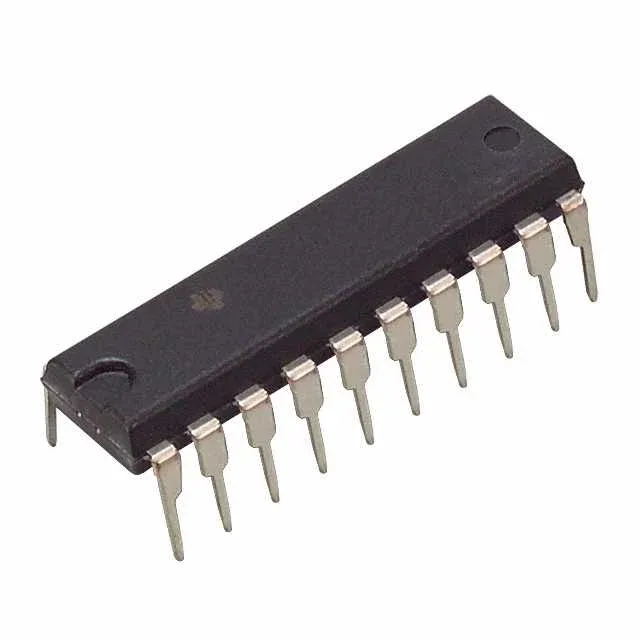
8-bit D-type register with tri-state inverted outputs
The CD74HC534E is an 8-bit D-type flip-flop from the 74HC family, clocked on the positive edge and delivering inverted outputs with tri-state control. It stores eight bits of data, with the Q-bar outputs gated by an output-enable line — pull it low to drive the bus, high to float.
60 MHz clock, 28 ns propagation delay — timing budget matters
That 28 ns is the pin-to-pin delay from clock edge to valid output; in a 5V system at 50 pF load, it's the number you budget for setup-and-hold calculations on the receiving device. At 2V the delay stretches, so if you're running near the low end of the 2V–6V supply range, expect slower throughput — derate accordingly for timing closure.
Military temperature range — not just a commercial part
Through-hole 20-DIP — legacy board or prototype socket
Packaged in a 20-pin DIP (0.300-inch body, 7.62 mm row spacing) with through-hole leads. That's the classic DIP footprint — sockets easily, hand-solders without reflow, and survives in boards where rework access matters. Not a surface-mount part; if your pick-and-place line expects SOIC or SSOP, this won't fit. But for a legacy retrofit, a breadboard prototype, or a high-reliability assembly that avoids BGA, the 20-PDIP is exactly what the BOM specifies.
Quiescent draw and output drive
Quiescent current sits at 8 µA typical — negligible for battery-backed or always-on rails. Output drive is symmetrical at 7.8 mA source and 7.8 mA sink per pin. That's enough to drive a few TTL inputs or a low-power LED indicator, but not enough for a relay coil or a high-capacitance bus without a buffer. Input capacitance is 10 pF per pin, so fan-out on a 5V bus is reasonable — about 10 standard 74HC loads before the rise time degrades.
ROHS3 compliant.