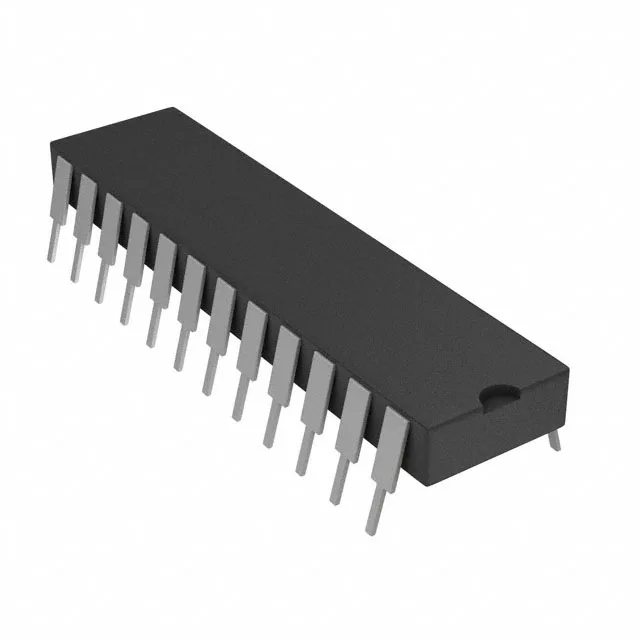
16:1 analog multiplexer — signal routing for harsh environments
It routes one of sixteen inputs to a common output, or demultiplexes a single input across sixteen outputs, controlled by a 4-bit binary address. The 89 MHz -3dB bandwidth supports analog signals well into the HF range, and the 160 Ohm max on-resistance with 8.5 Ohm channel-to-channel matching keeps insertion loss consistent across the mux bank.
On-resistance and switching speed — what they mean for signal integrity
The 160 Ohm max on-state resistance sets the series impedance in the signal path. For a 10 kOhm load, this introduces about 1.6% voltage drop — acceptable for most analog sensor signals, but worth derating if driving a low-impedance input. The 51 ns turn-on and 49 ns turn-off times allow switching rates up to roughly 10 MHz, adequate for audio, low-speed data acquisition, and control logic. Channel capacitance is 5 pF on the source side and 50 pF on the drain side. The 50 pF CD(off) capacitance loads the common output line; in a high-impedance circuit this can roll off bandwidth above a few MHz, so the 89 MHz bandwidth figure assumes a 50 Ohm source impedance. For precision DC applications, the 800 nA max off-leakage current is negligible — roughly 8 mV drop across a 10 kOhm pull-up.
Obsolete — sourcing the CD74HC4067E today
The mounting type is through-hole, which provides better mechanical retention than surface-mount in high-vibration environments, but limits board density.