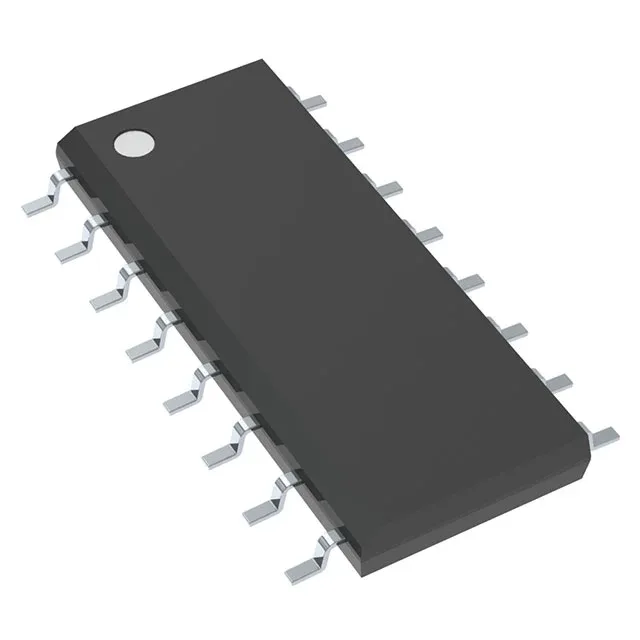
8:1 analog mux in a 16-SOIC — what the key specs mean for the signal path
The Texas Instruments CD74HC4051M96G3 is a single-circuit 8:1 analog multiplexer/demultiplexer in a 16-SOIC narrow body package. It routes one of eight analog or digital signals to a common output, or the reverse as a demultiplexer, controlled by three binary address lines and an active-low enable. The HC logic family brings 180 MHz of -3 dB bandwidth, so this part handles video, high-speed data acquisition, or RF switching well beyond the audio band. On-resistance is a maximum of 130 ohms with 5 ohms channel-to-channel matching, which keeps insertion loss uniform across channels in precision analog front-ends.
Supply rails and temperature — where this part lives
Single-supply operation spans 2 V to 6 V, and dual supplies from ±1 V to ±5 V are also supported. No AEC-Q100 grade is listed in the record, so for automotive under-hood applications you would need to confirm qualification status with TI directly.
Leakage and capacitance — loading the bus
Off-channel leakage is a maximum 400 nA, and channel capacitance measures 25 pF. For a 16-SOIC analog mux that is moderate — the 400 nA leakage matters in high-impedance sensor circuits where a 10 MΩ source impedance would see a 4 mV offset from one off-channel. The 25 pF capacitance per channel loads the analog bus when multiple muxes are paralleled, so budget for settling time if you are switching at high rates into a SAR ADC.