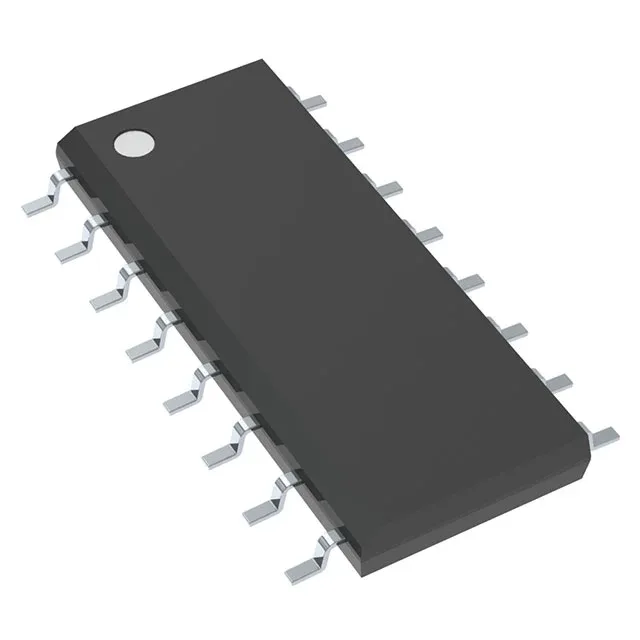
74ACT hex D-type with master reset — 80 MHz edge rate in a 5V logic rail
The Texas Instruments CD74ACT174M is a single-element, 6-bit D-type flip-flop from the 74ACT family, clocked on the positive edge with a non-inverted output and an asynchronous master reset. It runs on a 4.5V to 5.5V supply and clocks at 80 MHz, making it a drop-in for 5V TTL/CMOS bus-interface and register applications where you need six bits of storage with a clean reset line. The 24 mA source and sink drive per output gives it the fan-out to drive multiple CMOS loads or a short backplane trace without a buffer.
Military temperature range — the deployment envelope
The 80 MHz clock rate holds across that range, though the propagation delay of 14 ns at 5V and 50 pF load is the figure to budget for timing closure at the cold end, where CMOS switching slows slightly.
Supply rail and quiescent draw
The 4.5V to 5.5V supply range means this part lives on a regulated 5V rail — not 3.3V or 1.8V logic. Quiescent current is 8 µA typical, negligible for the power budget, but the dynamic draw scales with the 80 MHz clock and the 24 mA output switching load. Input capacitance is 10 pF per pin, which matters for the driving gate's rise-time budget when clocking at full speed.
Package and footprint — 16-SOIC narrow-body
Housed in a 16-SOIC narrow-body (3.90 mm width) package, surface-mount only. The 0.154-inch body width is the standard SOIC-16 footprint — no surprises for the PCB layout.
Qualifying a cross from a second manufacturer now avoids a single-source lock-in later.