Active production — no end-of-life risk for this BOM line
The CD74ACT02E: ROHS3 compliant, so it meets the EU Restriction of Hazardous Substances directive without exemption — no lead, mercury, or cadmium above the threshold limits.
Logic function and package — the fit decision for a legacy or new board
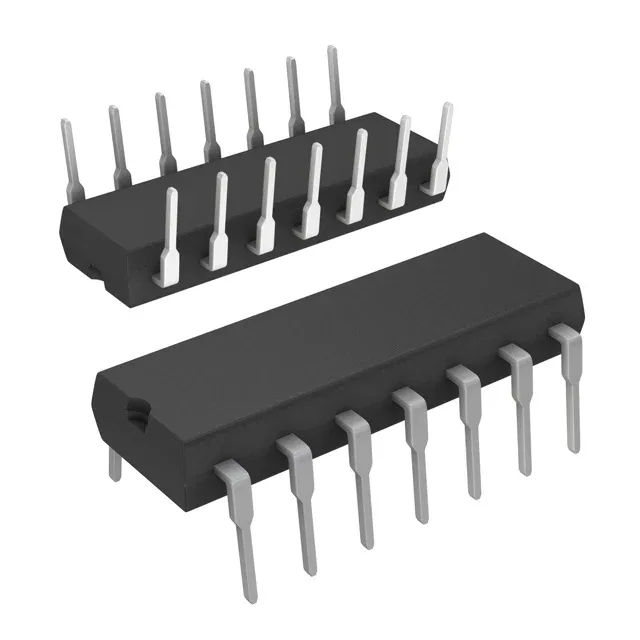
Quad 2-input NOR gate — four independent NOR gates in one package, each with two inputs. The logic function is fixed; a board that needs a NOR gate at a specific location can use this device without external pull-ups or inverters. 14-pin DIP package (0.300 inch row spacing, 7.62 mm body width) with through-hole leads. This is the standard dual-inline footprint that drops into a 14-pin socket or solders directly into plated through-holes on a PCB. No surface-mount reflow profile needed — suitable for hand-assembly or low-volume production.
Temperature grade and timing — what the ratings mean for a real circuit
This is the same temperature class as MIL-STD-883 screened parts — usable in avionics, engine-bay electronics, or outdoor telecom cabinets without derating the logic family for cold or hot extremes. Maximum propagation delay is 12.2 ns at 5 V supply driving a 50 pF load. In a 5 V system clocked at 40 MHz (25 ns period), the gate delay consumes about half the timing budget before accounting for interconnect and input capacitance — the remaining margin is tight but workable with careful PCB trace length matching. Input logic thresholds: Low at 0.8 V max, High at 2 V min. These are TTL-compatible levels — the gate interprets a 0.8 V input as logic low and a 2 V input as logic high, so it interfaces directly with standard 5 V TTL outputs without level shifting. Quiescent current is 4 µA maximum — the gate draws negligible current when the outputs are static. For a battery-backed or always-on logic block, this keeps the standby power below 20 µW at 5 V. Output drive capability is 24 mA sink and 24 mA source at the rated output voltage. This is enough to drive a standard LED (with a series resistor) or a 5 V relay coil through a transistor buffer, but not enough for a direct high-current load.