Quad NAND with Schmitt trigger — why the 4000B family still matters
The CD4093BPW is a quad 2-input NAND gate from the 4000B series, each input equipped with a Schmitt trigger. That hysteresis cleans up slow or noisy edges — think switch debounce, oscillator circuits, or squaring a sensor output that rises in tens of microseconds.
130 ns at 15V — the speed trade-off
Maximum propagation delay is 130 ns at 15V with a 50 pF load. That is slow compared to 74HC or 74LVC logic — the 74HCT132 runs about 33 ns at 4.5V. But the 4000B's noise margin and supply flexibility are the reason you pick it. In a motor-drive control signal path or a panel interface where the bus is a few kHz, the delay is irrelevant; the wide operating window is what keeps the design out of trouble.
4 µA quiescent — negligible standby draw
Quiescent current maxes at 4 µA across the full voltage and temperature range. That makes the CD4093BPW a candidate for battery-backed or always-on monitoring circuits where every microamp counts. The 3.4 mA output drive per channel is modest — enough to drive a CMOS input or a low-current LED, but not a relay coil directly.
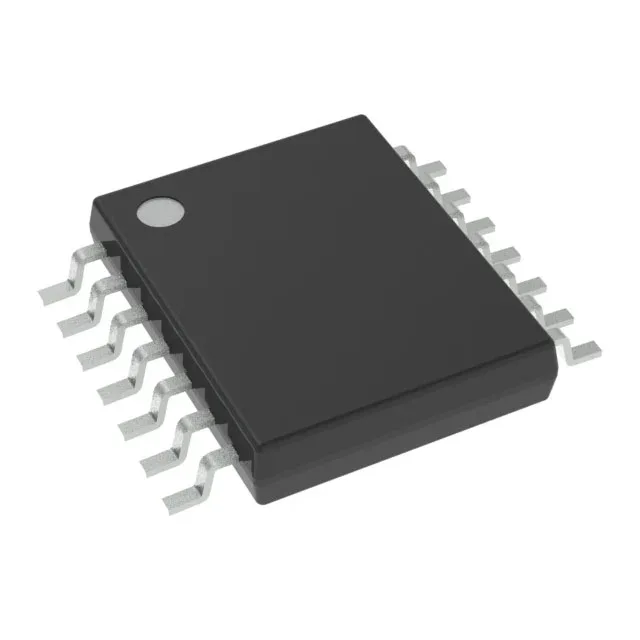
14-TSSOP — surface-mount footprint
The 14-TSSOP body (4.40 mm wide, 0.173" pitch) is a standard fine-pitch SOIC variant. It reflows with the same profile as other TSSOP packages; MSL is not stated in this record, but 4000B logic typically ships at MSL 1.
For new designs or BOM fills, there is no urgency to stockpile. The 4000B series has been in production for decades — TI shows no sign of retiring it.