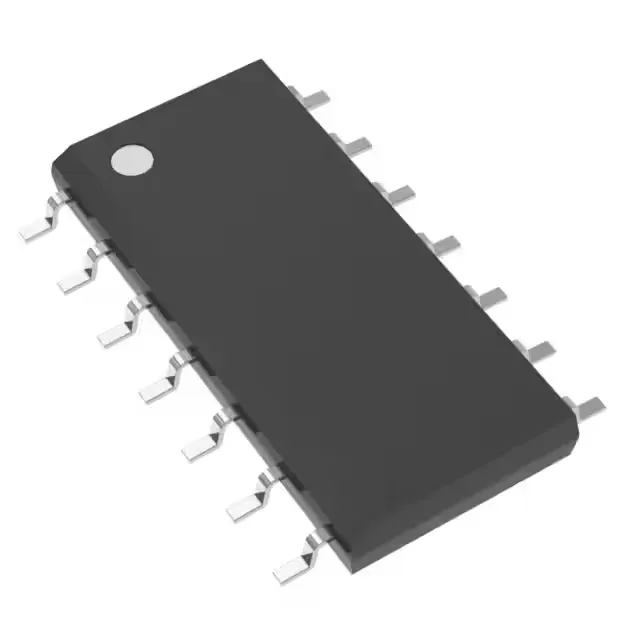
Quad 2-input NAND with Schmitt trigger — 3 V to 18 V supply
This gives it clean switching on noisy or slow-ramping signals — the hysteresis rejects glitches that a plain NAND would pass. Four independent gates in a single 14-SOIC package save board area compared to discrete transistor-level debounce circuits. The Schmitt trigger thresholds are specified as 0.9 V to 4 V for a low input and 3.6 V to 10.8 V for a high input at a 5 V supply, scaling with VDD. That's enough hysteresis to square up a slow RC oscillator or a mechanical switch contact without external components.
Maximum propagation delay is 130 ns at 15 V with a 50 pF load. That's the worst-case number across temperature and process — typical parts are faster, but the 130 ns ceiling is what you budget in the timing analysis. At lower supply voltages the delay increases; at 5 V it roughly doubles. For a 1 MHz clock or faster edge counting, this part is too slow — reach for a 74HCT or 74LV series gate instead. But for switch debounce, power-up sequencing, or a 50/60 Hz line-sync circuit, 130 ns is plenty of margin.
The 4000B series has been second-sourced by multiple manufacturers over the years, so supply depth is better than for niche logic families.
Military temperature grade — avionics and downhole use
The 14-SOIC package is surface-mount, so it survives the vibration profile of an avionics black box.
Output drive and fan-out
Each output sources or sinks 3.4 mA typical at 15 V. That's enough to drive one or two standard 4000B or 74HC inputs, but not a relay coil or LED directly — add a transistor buffer for loads above a few milliamps. The symmetrical source/sink current simplifies level translation: a 3.4 mA output into a 10 kΩ pull-up to 5 V gives a clean logic swing.