3V to 18V supply — the 4000B voltage reach
Its supply range of 3V to 18V is the widest among common CMOS logic families — 74HC tops out at 6V, 74HCT at 5.5V — which makes this the part to reach for when the rail is unregulated, runs on a battery stack, or needs to interface with 12V or 15V analog stages. The four gates share the same die and the same 14-PDIP package, so one CD4093BE handles a debounce, an oscillator, and a level translator on the same board.
That means it qualifies for avionics bay cards, outdoor base-station backplanes, engine-bay sensor interfaces, and downhole logging tools where the ambient hits 105°C and the self-heating adds another 20°C.
Schmitt-trigger inputs — what the hysteresis buys you
The Schmitt trigger on each of the four inputs sets separate low and high thresholds: 0.9V to 4V for a falling edge, 3.6V to 10.8V for a rising edge (both depend on supply voltage). The gap between them — the hysteresis — rejects noise that would otherwise cause multiple transitions on a slow ramp. This is the gate you pick for a relaxation oscillator (one RC network per gate), a pushbutton debounce front-end, or a sine-to-square converter from a transformer secondary. The 130ns propagation delay at 15V and 50pF load is adequate for sub-1 MHz switching; for faster edges the 74HCT132M96 runs 33ns at 4.5V but loses the wide supply range.
Through-hole 14-DIP — board-fit and sourcing reality
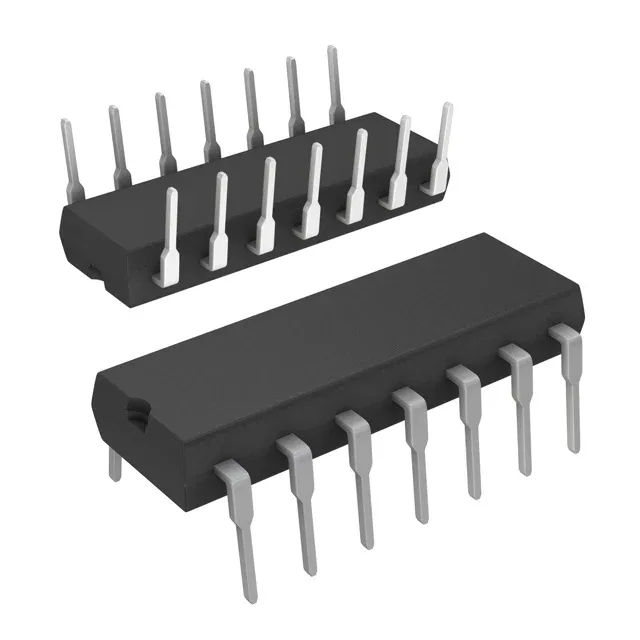
The 14-pin DIP with 0.300" body width (7.62mm) is the legacy through-hole footprint. It still dominates in breadboard prototypes, MRO replacement boards, low-volume industrial controls, and education kits where hand-soldering or socketing is the norm. The CD4093BE ships in a tube — not tape-and-reel — so if your pick-and-place line expects surface-mount, the CD74HCT132M96 (SOIC-14) is the footprint alternative, though it trades away the 18V supply and the full temperature range.
Quiescent current and output drive
Maximum quiescent current is 4 µA across the full supply range and temperature span — essentially leakage. That makes the CD4093BE a fit for battery-powered equipment that spends most of its life in standby with the gates idling. Output high and low current are both rated 3.4mA (typical, at 15V), enough to drive a standard CMOS logic input, a small LED through a series resistor, or the gate of a low-power MOSFET. For heavier loads — relay coils, high-speed bus lines — you would buffer the output or move to a 74HC part with higher drive.
Lifecycle — still active, but verify date-code
That said, the 4000B series is a mature logic family — production volumes are lower than 74HC or 74HCT — so the stock rotation at distributors can be slow. When sourcing, request the date-code and lot trace. A clean laser etch with consistent font across the tube is the baseline; any mismatch in marking depth or pad geometry on the 14-DIP body warrants a decap check before the reel hits the line.