What the 3V-to-18V supply range means for your rail
The CD4073BPWR is a triple 3-input AND gate from the 4000B series, running on a 3V to 18V supply. That wide operating window means it sits comfortably on a 5V logic rail, a 12V industrial bus, or a 9V battery — no level translator needed as long as the input thresholds align. Quiescent current maxes at 1 µA across the full voltage range, so in a battery-powered sensor node that spends most of its time asleep, this gate adds negligible drain to the standby budget.
Temperature grade and environment
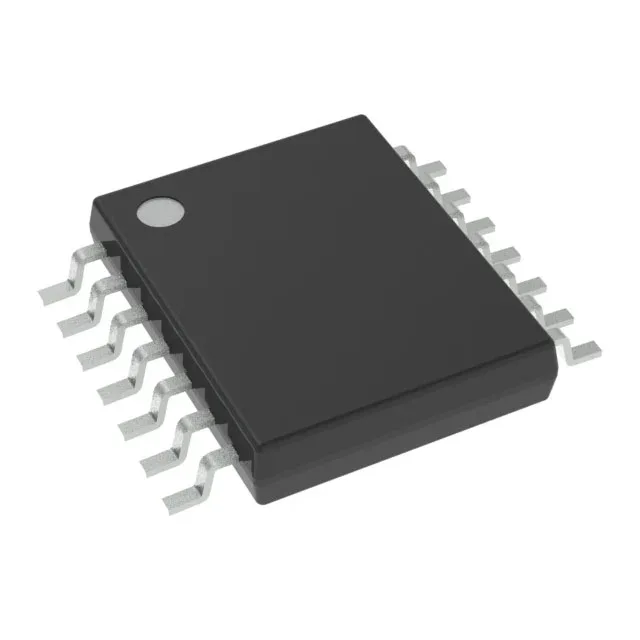
Rated for -55°C to 125°C, this is the full military temperature band. It handles the thermal swing inside an outdoor telecom enclosure or an engine-bay controller without derating the supply range. The 14-TSSOP package (4.40 mm width) is a fine-pitch surface-mount footprint — the 0.65 mm lead pitch demands a controlled solder profile, but the small body saves board area compared to a SOIC-14.
Output drive and propagation delay — the speed ceiling
Output current is 3.4 mA source and sink at the rated supply — enough to drive one or two standard CMOS loads, but not a heavy fan-out or a long trace without a buffer. Propagation delay is 90 ns typical at 15V into a 50 pF load; at lower supply voltages the delay increases, so for a 5V rail expect roughly double that figure. Input logic levels are ratiometric with the supply: low at 1.5V to 4V, high at 3.5V to 11V (both at VDD = 10V). That means a 3.3V microcontroller output may not reliably drive the gate at a 5V supply — check the VOH of the driver against the VIH spec for your rail.