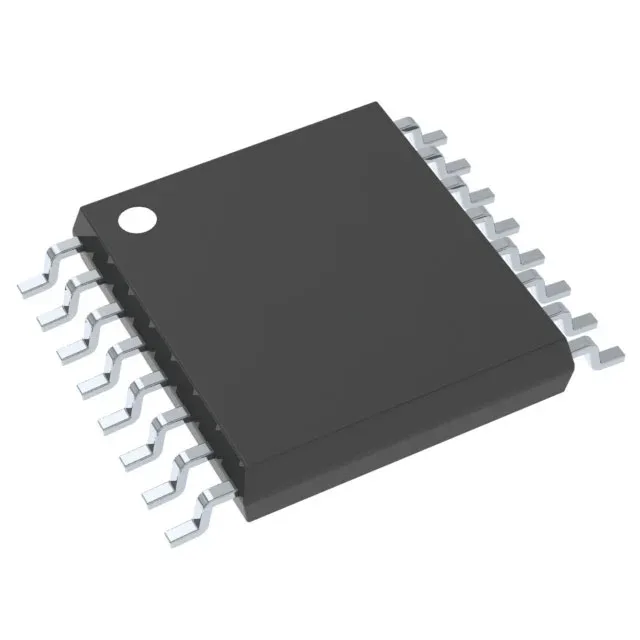
The Texas Instruments CD4053BPWR is a triple 2:1 analog multiplexer/demultiplexer with SPDT switch configuration per channel. It is part of the CD4000 logic family and comes in a 16-TSSOP surface-mount package. The part is designed for general-purpose analog or digital signal routing in systems that need to switch one of two inputs to a common output, three independent times. Key features include a maximum on-state resistance of 240 ohms, channel-to-channel matching within 5 ohms, and a -3 dB bandwidth of 30 MHz. Crosstalk between channels is specified at -40 dB at 6 MHz, which is relevant for multiplexing low-level analog signals without bleed-through. The part operates from a single supply of 3 V to 20 V or dual supplies of ±2.5 V to ±9 V, covering a wide range of analog signal swings. Typical applications include analog signal multiplexing in data acquisition, sample-and-hold circuits, audio routing, and digital control of analog paths in industrial and test equipment.
The 240 ohm maximum on-resistance is the series resistance between the source and drain when the switch is closed. For a 10 kohm load, this adds about 2.4% attenuation — acceptable for many logic-level or high-impedance analog signals. If you are switching into a low-impedance load (e.g., 600 ohm audio), the voltage drop and attenuation become significant; plan for gain compensation or buffer the output. The 5 ohm channel-to-channel matching helps keep gain errors consistent across the three switches, which matters when the three channels are part of a ratiometric measurement.
Bandwidth and crosstalk — the analog performance envelope
The 30 MHz -3 dB bandwidth means the switch can pass signals up to about 30 MHz before the amplitude drops by half. For audio, baseband video, or moderate-speed data acquisition (up to a few MHz), this is plenty of margin. The -40 dB crosstalk at 6 MHz tells you how much of the signal on one channel leaks into another when the other channel is off. At 6 MHz, -40 dB means about 1% leakage — acceptable for many multiplexed analog systems, but if you are switching sub-millivolt sensor signals at high frequency, you may need a part with better isolation (e.g., -80 dB).
The CD4053BPWR is supplied in a 16-TSSOP package (4.40 mm body width, 0.65 mm pin pitch). It is a surface-mount part intended for reflow soldering. The tape-and-reel and cut-tape options are available for prototyping or production volume. The 16-TSSOP footprint is shared with many other CD4000-family logic parts, so a common PCB land pattern can serve multiple BOM variants.