Wide-supply hex buffer for mixed-voltage and harsh-environment boards
The Texas Instruments CD4050BE is a hex non-inverting buffer from the 4000B series, built in CMOS logic. It accepts a supply range from 3V to 18V, which lets it interface between 5V TTL, 12V industrial logic, and 15V analog rails without a level shifter.
3V to 18V supply — one buffer for multiple logic families
The CD4050BE operates from 3V to 18V supply.
8mA source / 48mA sink — real drive for real loads
The output drive is generous for a CMOS buffer. The 48mA sink capability can directly energise a 24V relay coil through a series resistor and a small-signal transistor, or drive a bank of low-current LEDs. The 8mA source is enough to charge the gate capacitance of a logic-level MOSFET or feed a 5V TTL input. For heavier loads, the push-pull stage can be paralleled across multiple buffers (same input) to increase drive — just watch the package thermal limits.
Through-hole DIP — still the repair-bench and breadboard standard
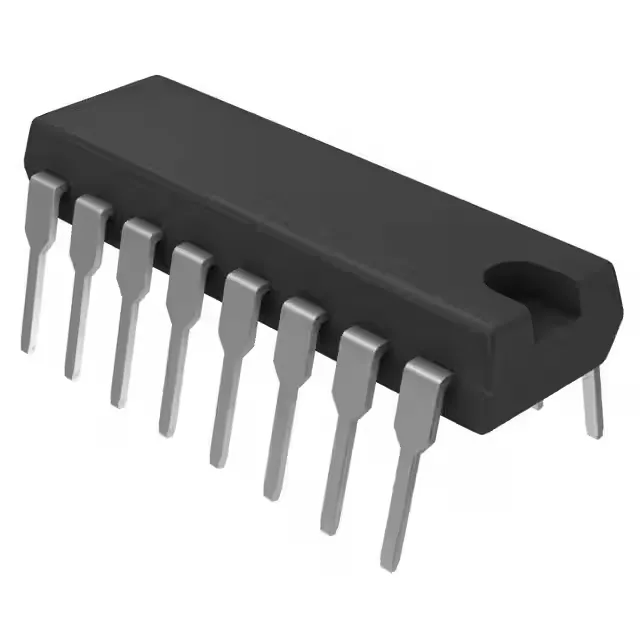
The 16-pin DIP package (0.300" width, 7.62mm row spacing) is a legacy footprint that remains common in industrial control cards, test equipment, and prototyping. It fits standard breadboards, wire-wrap sockets, and IC extraction tools. For repair depots and MRO shops, this means the part can be swapped without hot-air rework — a soldering iron and a desoldering pump are enough.
For long-life programs in industrial, aerospace, or defence, this part is a safe line item to qualify into the BOM. If a second-source concern arises, the 4000B series is broadly second-sourced by multiple manufacturers — the CD4050BE pinout is standard across the industry.